
Blood and plasma treatments: what the evidence supports
Plasma is a busy part of the body: it carries proteins, immune signals and other substances between tissues. Changing what circulates in it can be a powerful medical tool, and researchers are now exploring applications in healthy aging. From lowering certain pollutants to studying plasma-derived signals, the field offers several different ideas. Understanding what each procedure removes or adds is the key to understanding its promise.
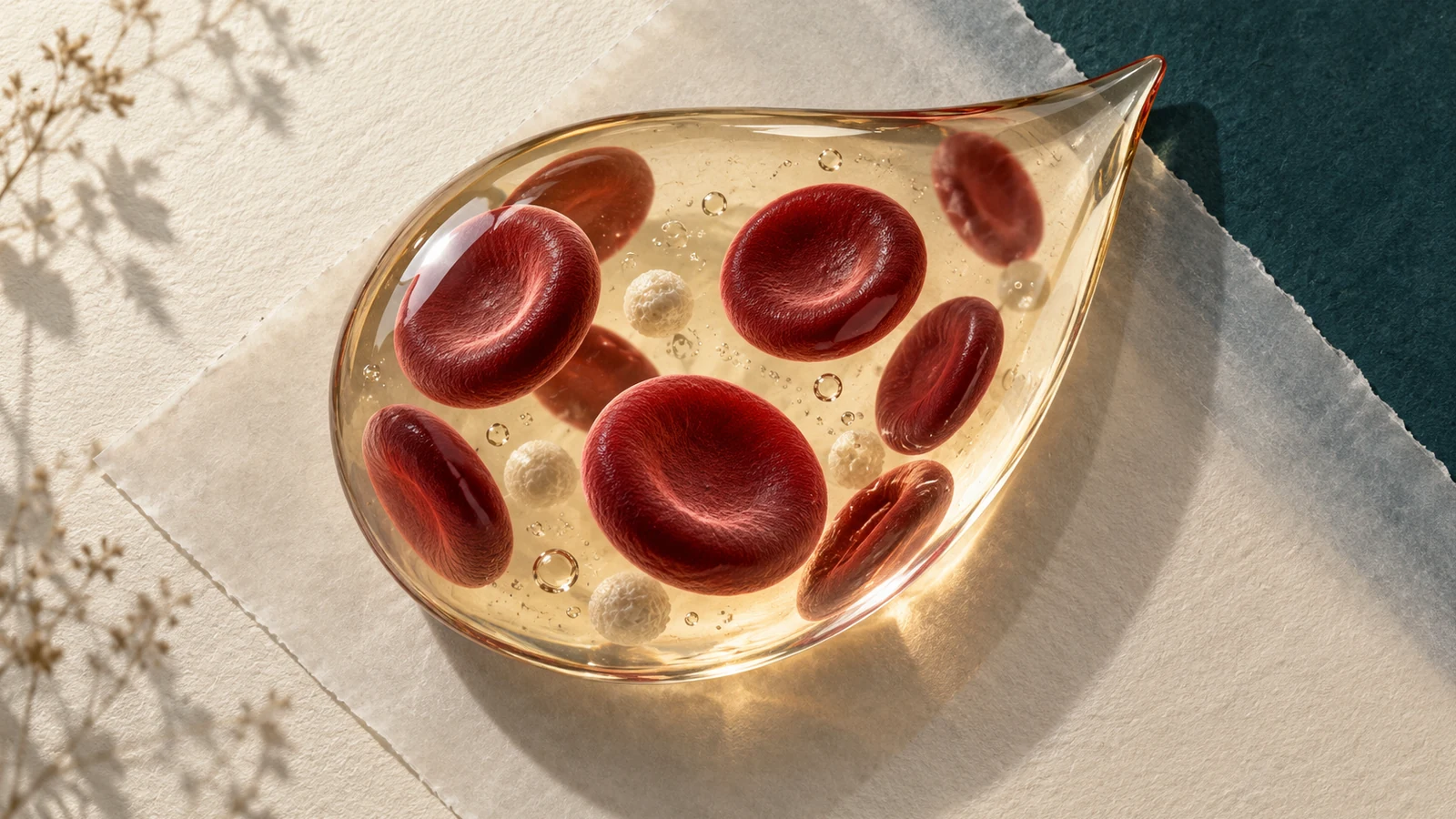
Blood is often described as a transport system. Its liquid component, plasma, is also part of the body's communication network, carrying antibodies, clotting factors and many other proteins. In some diseases, removing harmful substances from plasma can make a major difference. That established medical use has inspired broader questions about whether changing the circulating environment could also support healthier aging. [1] [17]
The research spans several ideas: removing unwanted substances, replacing part of the plasma, filtering it, or adding selected components. Each starts from a different biological question.
Our connection to plasma research
Healthy Longevity Clinic is proud to contribute to this field. Petr Sramek coauthored a study of plasma donation and aging markers, contributing to its concept and funding acquisition. We also support new approaches through Longevity Tech Fund, whose portfolio includes Yuvan Research, the developer of E5, and HLC. These connections give us a close interest in what the research can teach us. [5] [11]
Four approaches that are easy to confuse
Approach | What happens |
|---|---|
Plasma donation | Plasma is collected from a donor and blood cells are returned. The body replenishes what was collected. |
Therapeutic plasma exchange | Plasma is removed and replaced with prescribed fluid, often albumin solution or donor plasma. |
Double filtration | Plasma passes through an additional filter before the remaining plasma returns to the circulation. |
A plasma-derived fraction | A selected preparation made from plasma is given to the recipient. |
The umbrella term “plasmapheresis” can be used in different ways. The useful starting point is therefore simple: what is being removed, what is being returned, and what change is the treatment intended to achieve? [1] [3] [6] [16]
Where plasma exchange already helps
Some illnesses involve harmful antibodies or excessive proteins circulating in plasma. Exchange can reduce them while other treatment addresses the underlying disease. It has established uses in selected blood and neurological disorders, including thrombotic thrombocytopenic purpura, a serious condition affecting small blood vessels. [1] [2] [17]
In these settings, the procedure has a clear medical purpose. Specialists choose the replacement fluid and schedule around the illness and the patient's needs. Applying the same technique to aging asks a new question: which aspect of health could improve, and does the expected benefit justify the procedure?
Can removing plasma lower pollutants?
A well-known Australian study provides an encouraging answer for certain PFAS chemicals. These persistent compounds can accumulate in the body. Among 285 eligible fire-service personnel, repeated plasma donation over a year lowered blood concentrations of selected PFAS. Whole-blood donation also had an effect, although it was smaller under the schedule tested. [3]
The chemical reduction is a real finding. Whether that reduction prevents illness is a further question the trial did not answer. It also does not mean that a clinic procedure will remove every pollutant. Reducing ongoing exposure remains important. [9]
Microplastics need their own research because they are particles, not the same kind of substance as PFAS. Early plasma-exchange findings are mixed: one study found lower counts after treatment in groups starting with higher values, but higher counts in its largest group, which started with lower values. Measuring tiny particles reliably and avoiding contamination are continuing challenges. [8]
Finding plastic-like material in a filter is also only part of the story. Researchers still need to establish how much is removed from the body, whether levels stay lower and whether people benefit. [16]
What about aging clocks?
Aging clocks use biological measurements to estimate aspects of aging. They can be useful research tools, especially when studied alongside physical function and health.
One human study of plasma exchange found favorable clock changes at an intermediate assessment, but the average differences from a simulated-treatment group were no longer clear at the final measurement. Some participants also received an antibody preparation called IVIG, which makes the contribution of exchange alone harder to isolate. [4]
A separate donation study involving an HLC-affiliated coauthor did not find clear epigenetic rejuvenation, and some clock estimates moved upward. It examined donation without albumin replacement. Together, the studies show why the procedure and timing matter—and why a clock result needs to be connected with how people feel and function. They do not measure years of life gained or lost. [5] [10]
Adding plasma components: the E5 idea
Instead of removing material, E5 adds a processed fraction from young pigs' plasma. Small rat studies reported changes in molecular age estimates and encouraging functional findings. A later experiment followed eight treated and eight control female rats and found longer average survival in the E5 group. [6] [7]
That survival finding makes E5 especially interesting to follow. It remains an animal result, and researchers need to understand the active components, reproduce the effects and study the preparation directly in people. Its results cannot be transferred to an infusion of whole human plasma.
Human plasma fractions are being explored too. In a trial around joint-replacement surgery, GRF6021 changed immune and inflammatory measurements but did not show a clear advantage in pain or fatigue recovery. A small Norwegian study of young-donor plasma exchange in people with cognitive impairment explored feasibility and safety, with adverse events in every participant. These are different products and different research questions. [15] [13]
The experience and risks of treatment matter
Plasma exchange takes time, requires venous access and changes the balance of substances in the blood. Possible problems include low blood pressure, allergic reactions, changes in calcium and clotting proteins, and complications from a venous line. The fluid used and the person's health affect that balance. [1] [17]
That is why a clear reason for treatment matters. A procedure that is worthwhile for a serious illness needs its own assessment when proposed to a healthy person. The US FDA has also warned about young human-donor plasma sold for unproven aging and memory uses. A trial listing or company registration does not make a treatment approved. [2]
A useful way to discuss the possibilities
Healthy Longevity Clinic’s clinical research perspective starts with the health goal. If the concern is a pollutant, we ask whether its level can be reduced and whether that helps health. If the goal is independence, we look for improvements in movement, thinking and daily life. Molecular measurements help explain what may be happening along the way.
For a consultation, three questions bring the discussion into focus: which exact procedure is proposed, what benefit is expected for someone like you, and how will benefit and unwanted effects be monitored? Plasma research is producing useful discoveries. Their value becomes clearer when each is connected to the problem it can help solve.
What remains uncertain
A lower pollutant level or aging-clock estimate does not by itself establish better health. Microplastic findings need more reliable and lasting measurements, and E5 needs direct human studies. The benefit and risk depend on the exact procedure, product and reason for treatment.
References
- Plasma exchange service at NHNN.
- Update to important information about young donor plasma infusions offered for profit.
- Effect of plasma and blood donations on levels of perfluoroalkyl and polyfluoroalkyl substances in firefighters in Australia: a randomized clinical trial.
- Multi-omics analysis reveals biomarkers that contribute to biological age rejuvenation in response to single-blinded randomized placebo-controlled therapeutic plasma exchange.
- Human clinical trial of plasmapheresis effects on biomarkers of aging (efficacy and safety trial).
- Reversal of biological age in multiple rat organs by young porcine plasma fraction.
- E5 treatment showing improved health-span and lifespan in old Sprague Dawley rats.
- Can plasma exchange be used to lower the circulating burden of microplastics in human patients?
- Clinical evaluation and management: PFAS information for clinicians.
- FDA facts: biomarkers and surrogate endpoints.
- Public portfolio.
- Therapeutic plasma exchange.
- Interstitial fluid rejuvenation through young-donor plasma exchange in cognitively impaired patients: a pilot safety and feasibility study.
- The effects of therapeutic plasma exchange on age-related biomarkers and epigenetics, NCT06534450.
- Infusion of young donor plasma components in older patients modifies the immune and inflammatory response to surgical tissue injury: a randomized clinical trial.
- Therapeutic apheresis: a promising method to remove microplastics?
- Plasma exchange.
Disclosure
Prepared with AI assistance. Healthy Longevity Clinic has a clinical and commercial interest in plasma exchange and contributed an affiliated coauthor to the donation study. HLC and Yuvan Research are Longevity Tech Fund portfolio companies. Several cited studies include researchers connected with product developers or treatment providers; their publications contain the detailed funding and author disclosures.