
BPC-157: human healing claims still outrun the evidence
BPC-157 has not convincingly shown that it heals injuries in people. A September 2026 analysis found 279 reports of improvement among 1,039 users—but 685 had no recorded outcome. Small human studies offer clues, not a reliable benefit or safety estimate. A planned 120-person hamstring trial could provide a stronger test.

Evidence as of September 2026.
Shown: laboratory and animal studies suggest effects on repair; small human reports describe symptom improvement and adverse experiences. [1] [2] [3] [4] [5]
Not shown: dependable healing of human injuries in a completed controlled trial, or a reliable long-term safety profile. [1] [11]
Would change the assessment: results from the registered 120-person hamstring trial, including recovery, MRI findings and harms. [11]
Why 279 improvements are not a treatment success rate
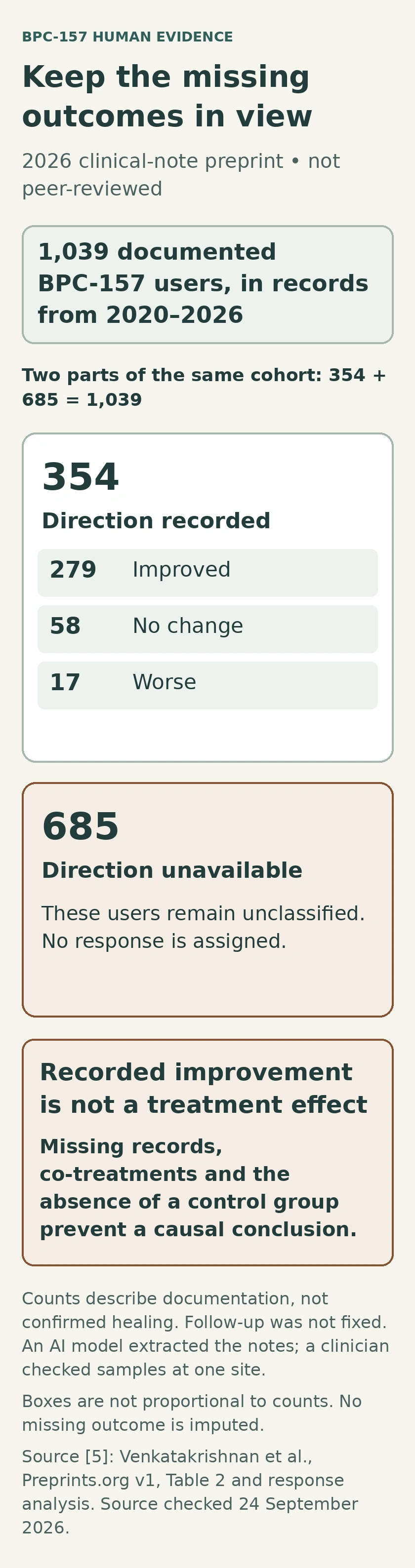
The largest BPC-157 report cannot tell us how often the peptide works. In a preprint dated September 7, 2026, researchers used an AI language model to read clinical notes for 1,039 people with documented use. Only 354 had a recorded direction of symptom change: 279 improved, 58 were unchanged and 17 worsened. The other 685 had no outcome recorded. [5]
Missing outcomes are neither successes nor failures. There was no comparison group, and about half the users had other therapeutic agents recorded. Recovery, rehabilitation, other treatments and expectations could all contribute. A clinician checked samples of the AI-extracted information at one site; recording and extraction errors remain possible. The report had not completed peer review. [5]
Among 129 people whose notes confirmed stopping BPC-157, adverse effects were the recorded reason in 24. Incomplete reporting means that count is not a dependable side-effect rate. The authors reported employment by the data-analysis company nference. [5]
What the human studies actually found
Human use has been studied, but the reports do not yet establish a dependable treatment for injury. Calling BPC-157 “untested in people” would erase these studies; calling it a proven healing drug would overstate them.
Study | Reported result | Verdict |
|---|---|---|
Knee pain, 2021 | 11 of 12 using BPC-157 alone reported improvement | Symptom improvement; cause unknown [2] |
Bladder pain, 2024 | 10 of 12 reported complete relief; two substantial improvement | Symptom improvement; durability unclear [3] |
Intravenous pilot, 2025 | Two previously exposed adults; three days of monitoring | No detected short-term change; long-term safety unknown [4] |
Ulcerative colitis, 2005 abstract | 53 randomized; 46 completed two weeks | No clear between-group benefit [1] |
The knee report relied on telephone follow-up and had no control group or planned demonstration of tissue repair. Seven of the 12 BPC-157-only patients reported relief lasting six months to a year. Four additional patients received a peptide combination, so their experience cannot isolate BPC-157. Patients paid for treatment; the authors declared no conflicts. [2]
The bladder study involved a specific procedure for women with interstitial cystitis, a condition causing bladder pain. Its summary did not state follow-up duration and reported no adverse events. Two people with reassuring short-term infusion results are too few to detect uncommon or delayed harms. [3] [4]
The bowel-disease trial was placebo-controlled, but the available conference summary was too incomplete for a firm conclusion. Its uncertainty range included no difference. Three BPC-157 participants and two placebo participants withdrew because of adverse events, mainly disease progression; those withdrawals do not by themselves prove treatment caused deterioration. [1]
Why scientists are interested
BPC-157 is a synthetic chain of 15 amino acids, the building blocks of proteins. The research question is whether its effects on cells can produce useful repair in a whole person. [1]
In 2011, BPC-157 increased movement and survival of rat tendon cells, but did not directly speed their multiplication in the test used. A 2026 study linked effects in laboratory-grown human blood-vessel cells to proteins called FBXO22 and BACH1, and also studied rodent injuries. Human cells in a dish are not treated patients. The later team described a patented synthesis method and injectable-product development while declaring no competing interests. [13] [14]
What are the risks?
The main safety problem is the lack of dependable human follow-up. FDA also identifies potential immune reactions, impurities and difficulty adequately characterizing the ingredient. Free-base and acetate forms, and local, intravenous and oral preparations, should not be treated as interchangeable. [1] [6]
In 28-day injection studies in rats and dogs, FDA highlighted changes in clotting and liver-related measurements. The authors considered the changes incidental; FDA considered them potentially important. These findings warrant investigation but do not tell us the rate of harm in people. [1]
Cancer risk is unresolved. FDA found no studies establishing the carcinogenic potential of the reviewed forms. Blood-vessel growth in a laboratory does not prove that BPC-157 causes human cancer, and short reports without detected problems do not establish cancer safety. [1]
What would change our assessment?
The registered hamstring trial offers a more useful test because both groups would receive the same rehabilitation and differ in BPC-157 or placebo. NCT07437547 plans 120 adults aged 18–45 with MRI-confirmed muscle injury; planned outcomes include return to unrestricted sport through eight weeks and injured-tissue volume on day 14. [11]
Trial results: the February 27, 2026 registry update listed recruitment in Shenzhen by Hudson Biotech, with no results posted in that entry. Watch for completed enrollment, results and full reporting. [11]
Safety follow-up: useful reporting must include adverse events and withdrawals, not only people who improve. [1] [11]
US regulatory action: the July 23, 2026 advisory agenda concerned BPC-157 forms for ulcerative colitis. A committee discussion or recommendation is not drug approval. [8] [12]
How Healthy Longevity Clinic experts evaluate the evidence
Healthy Longevity Clinic's interest in an injury treatment is whether it helps a person return to the activity they value, with acceptable risks. For BPC-157, the decisive gap is that reports of improvement cannot reliably show how much recovery the peptide caused. In the clinical-note study, outcomes were missing for 685 of 1,039 people; the improvements among those with follow-up cannot become a success rate for everyone.
Our reading is therefore specific: BPC-157 merits a proper test, but the current human record does not support a confident promise of injury healing. The planned hamstring study could help if it reports meaningful recovery and harms against a suitable comparison. Its results would apply first to the preparation and injury actually studied.
For the reader, the useful next question is what explains the injury and how recovery will be measured. A clear diagnosis and rehabilitation plan provide a firmer starting point than an advertised peptide success rate.
Three questions for a treatment discussion
Is the promised result less pain, repaired tissue or return to sport—and which study measured it?
Does the study use the same chemical form, route and condition being proposed?
How would recovery and harms be assessed alongside rehabilitation, and which sport rules apply?
Frequently asked questions
Does BPC-157 work for injuries?
The available human reports do not reliably establish injury healing. Some people reported symptom relief, but the studies cannot separate the peptide’s effect from other explanations. [1] [2] [5]
Is BPC-157 FDA-approved?
BPC-157 is unapproved. The July 2026 compounding discussion did not approve it for injury recovery or longevity; “off-label” properly describes a different use of an already approved drug. [8] [9] [12]
Is BPC-157 banned in sport?
The 2026 WADA list names BPC-157 under S0 and prohibits it in and out of competition. USADA describes a therapeutic-use exemption as unlikely, with applications considered individually; a prescription is not an automatic exemption. [7] [10]
What remains uncertain
The studies use different preparations, routes and conditions. Incomplete follow-up, missing outcomes and other treatments prevent a dependable estimate of benefit or harm. Long-term safety, uncommon adverse effects and cancer risk remain unresolved.
References
- FDA Evaluation of BPC-157-related bulk drug substances
- Lee and Padgett: Intra-Articular Injection of BPC 157 for Multiple Types of Knee Pain
- Lee, Walker and Ayadi: Effect of BPC-157 on Symptoms in Patients with Interstitial Cystitis
- Lee and Burgess: Safety of Intravenous Infusion of BPC157 in Humans: A Pilot Study
- Venkatakrishnan et al.: Rising Use of Unapproved BPC-157 and Associated Patient-Reported Outcomes Curated from Clinical Notes
- FDA Certain Bulk Drug Substances for Use in Compounding that May Present Significant Safety Risks
- USADA BPC-157: What Athletes Should Know About the Prohibited Experimental Peptide
- FDA July 23–24, 2026 PCAC meeting
- FDA Understanding Unapproved Use of Approved Drugs Off Label
- WADA 2026 Prohibited List
- ClinicalTrials.gov NCT07437547: BPC 157 for Acute Hamstring Muscle Strain Repair
- FDA Bulk Drug Substances Used in Compounding Under Section 503A of the FD&C Act
- Chang CH et al. The promoting effect of pentadecapeptide BPC 157 on tendon healing involves tendon outgrowth, cell survival, and cell migration. Journal of Applied Physiology, 2011.
- Zhang J et al. BPC157 drives angiogenesis through FBXO22-dependent stabilization of BACH1. Cell Communication and Signaling, 2026.
Disclosure
Prepared with AI assistance.