
Can plasma donation remove PFAS and microplastics?
Repeated plasma donation lowered selected PFAS blood levels in a randomized trial of 285 Australian fire-service personnel. After a year, PFOS fell by an average of 2.9 ng/mL in the plasma group. That is a real measured effect. It does not establish permanent clearance from the whole body or better health, and the findings cannot be transferred to microplastics.
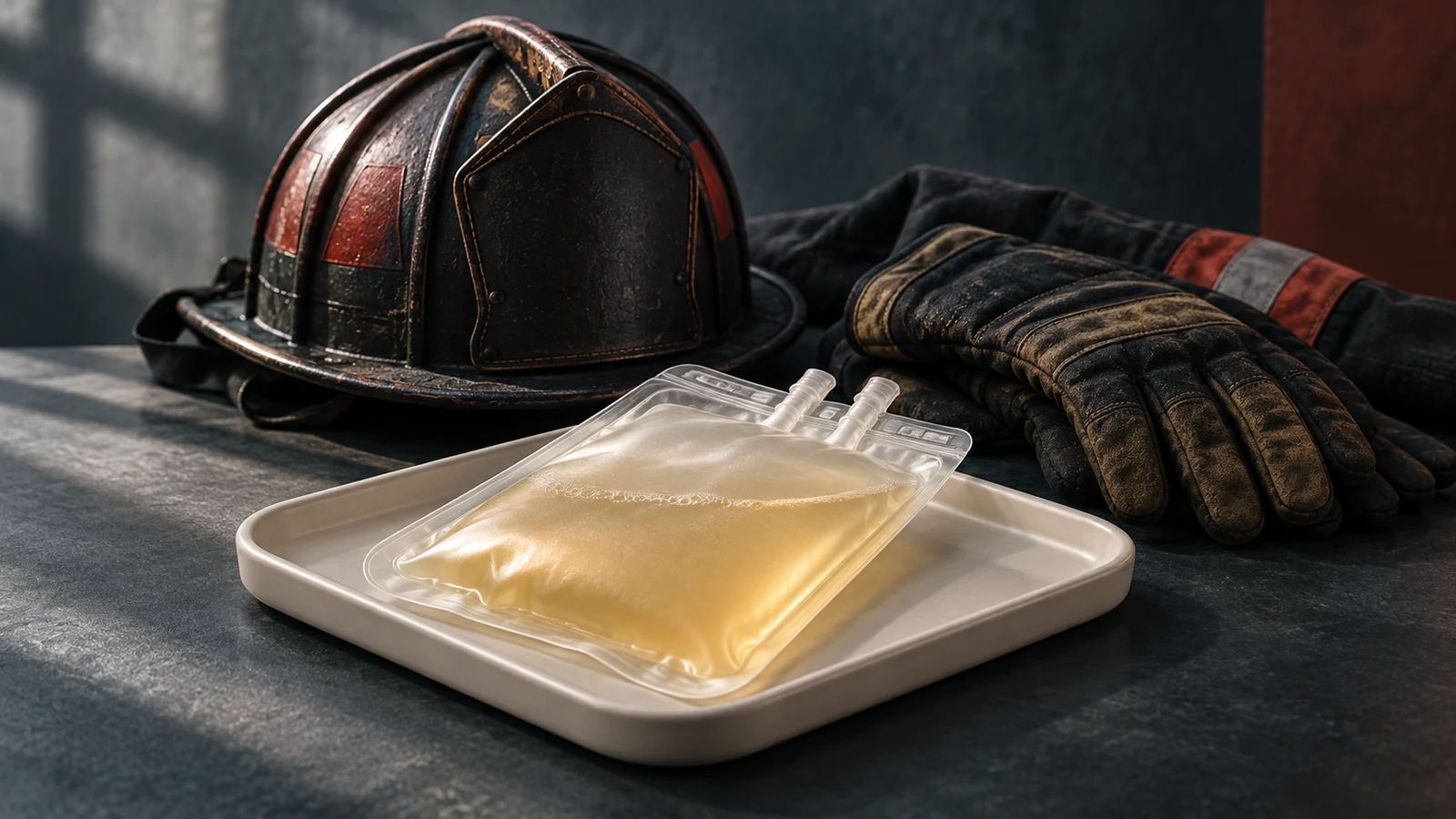
Removing plasma can lower the blood concentration of some pollutants. The randomized trial showing lower PFAS levels used ordinary plasma donation. It did not test elective therapeutic plasma exchange. To judge a proposed procedure, match the exact substance, removal method and outcome: a lower blood result, removal from organs and better long-term health are different findings. [1] [4] [5] [6]
Healthy Longevity Clinic publicly listed therapeutic plasma exchange in September 2026, creating a commercial interest in this topic. That listing is not evidence of a PFAS- or microplastic-removal benefit. [10]
What has been shown?
Shown: repeated plasma donation lowered selected PFAS concentrations in eligible Australian fire-service personnel, with differences still present after 12 additional weeks without donation. [1]
Not shown: the trial did not establish fewer illnesses or permanent clearance throughout the body. Early microplastic studies reported mixed immediate measurements, not lasting tissue removal or better health. [1] [4] [5] [6]
What would change the assessment: controlled studies of the exact procedure showing a sustained effect and meaningful health benefits that outweigh the procedure’s risks.
Donation, exchange and filtration are different procedures
Plasma is the liquid component of blood. Procedures that remove or filter it differ in what they return and replace. [1] [9]
Procedure | What happens | Evidence and limits |
|---|---|---|
Plasma donation | A machine collects some plasma and returns blood cells; the body replenishes the collected material | The Australian randomized PFAS trial used donation under blood-service eligibility and frequency rules. [1] |
Therapeutic plasma exchange, or TPE | A larger planned amount of plasma is removed and replaced with fluid such as albumin solution or donor plasma | An established treatment component for selected diseases; the May 2026 microplastic study examined TPE. [4] [9] |
Double-filtration plasmapheresis | Plasma passes through an additional filter intended to retain selected substances, with remaining plasma returned | The 2025 microplastic report examined material collected during this technique. [5] |
A result from one procedure cannot establish the benefit of another. Collection volume, frequency, replacement fluid and filtration system change the intervention. Receiving plasma from a young donor is another distinct approach; the PFAS donation trial did not test it. [1] [5] [9]
The PFAS trial: a measurable reduction over a year
PFAS stands for per- and polyfluoroalkyl substances, a large family of manufactured chemicals. Some persist in the body for years and bind to proteins in blood, making plasma removal a plausible way to reduce circulating levels. A trial published in JAMA Network Open in 2022 tested that idea in people. [1]
Researchers randomly assigned 285 Fire Rescue Victoria employees and contractors to plasma donation, whole-blood donation or observation, with 95 in each group. All were eligible to donate and had an initial PFOS concentration of at least 5 nanograms per milliliter (ng/mL). PFOS is one particular PFAS chemical. Participants averaged 53 years of age; 279 were men and six were women. This was a selected occupational group. [1]
Over a year, the plasma group could donate up to 800 milliliters every six weeks, for a maximum of nine donations. The whole-blood group could donate approximately 470 milliliters every 12 weeks, for a maximum of five. Actual averages were 6.4 plasma donations and 4.3 whole-blood donations. These were study procedures, not a personal donation schedule. [1]
At 52 weeks, average PFOS concentration had fallen by 2.9 ng/mL within the plasma group and by 1.1 ng/mL within the whole-blood group. The observation group changed by −0.01 ng/mL, essentially unchanged. Those figures compare each group with its own starting value. The adjusted comparison between plasma donation and observation found PFOS 3.1 ng/mL lower with plasma donation, with a 95% confidence interval of 2.4 to 3.8 ng/mL lower. [1]
Plasma donation also lowered PFHxS, another measured PFAS. This does not establish equal removal of every PFAS chemical. Nor did the trial compare equal amounts of plasma and whole-blood removal: donation frequency and volume differed. [1]
The trial continued for 12 weeks without donation. Differences between groups remained at week 64, although concentrations of some measured compounds rose slightly. Continued exposure, movement between blood and other parts of the body, and measurement variation can complicate interpretation. Persistence over those 12 weeks is useful evidence of duration, not proof of permanent clearance. [1]
Did participants become healthier?
The study established a change in measured exposure. It did not establish fewer cancers, heart attacks or other illnesses. Routine cholesterol, thyroid, liver and kidney measures did not improve significantly between groups. Whole-blood donation reduced hemoglobin, the oxygen-carrying protein in red blood cells, and adverse events were more frequent in the plasma group. A useful laboratory effect can coexist with costs and risks. [1]
The participants’ exposure, donation eligibility and predominantly male composition matter. Results do not automatically transfer to someone with a low PFAS concentration, anemia, cardiovascular disease or a different exposure history. The trial does not establish a level at which treatment becomes beneficial or a number of sessions that improves health. [1]
A blood concentration is also not the total amount in the body. A blood sample measures one part of the body at one time. After removal, substances can move into blood from elsewhere, or exposure can continue. Lasting benefit needs follow-up measurements and patient outcomes, not just a sample taken immediately after the procedure. [1] [6]
A US firefighter protocol is a plan, not a result
A US firefighter research program published a protocol in 2025 that includes donation and PFAS measurements. Other parts of the program examine exercise or intermittent fasting. Their aims should not be combined into proven benefits of donation. [2]
As of September 21, 2026, its ClinicalTrials.gov record, Firefighter Collaborative Research Project (NCT05869747), had no posted results. The record’s last update was in June 2025, so its estimated completion date cannot confirm completion or successful outcomes. An empty registry results section also does not establish that no results exist elsewhere. [3]
Microplastics need separate evidence
PFAS molecules and plastic particles are different materials. Removing a chemical bound to blood proteins does not establish removal of plastic fragments, especially particles embedded in an organ. The human reports examined different procedures and measurements. [1] [4] [5]
Plastic-like signals in collected material
A 2025 report studied material collected during double-filtration apheresis in 21 people with postinfectious myalgic encephalomyelitis/chronic fatigue syndrome, or ME/CFS. Spectroscopy, a method for identifying material by its interaction with light, detected signals resembling plastic-containing material. The authors cautioned that some signals could partly reflect proteins. [5]
This was a qualitative analysis of material in the collected waste. It did not quantify a fall in plastic levels in the patients’ blood or tissues, or demonstrate symptom improvement caused by plastic removal. Finding something in the collection system and showing a beneficial reduction in the person are different questions. [5]
Immediate particle counts after plasma exchange
A May 2026 study reported 114 patients undergoing 174 TPE procedures. Its assay classified particles as microplastics. Immediate counts fell in groups with higher starting counts, but rose in the largest group: 100 procedures with the lowest starting counts. Of the four groups defined by starting counts, the second lowest showed no statistically significant decrease. These groups were defined by starting measurements; they were not randomized patient groups, and some people contributed several procedures. [4]
The assay used a fluorescent stain and detected particles at least one micrometer across. It could not assess smaller nanoplastics, and its validation data were proprietary. Tests of saline and equipment suggested that bags or tubing could add particles, without establishing the origin of every particle in a patient sample. [4]
There was no control group. Grouping observations by high or low starting values also raises the possibility of regression to the mean: unusually high or low measurements can move toward the average when repeated. That is a possible contribution, not a proven explanation for a particular patient’s change. Together, the design and measurement limits prevent a reliable estimate of an individual treatment effect. The study did not establish lasting tissue reduction or clinical benefit. [4]
An August 2026 research update
TU Dresden’s August 19 institutional account of an August 4 paper described several filtration approaches and adsorption, which captures substances on a material’s surface. It reported small exploratory samples, mixed plastic measurements, no randomized comparison and no long-term outcomes. The institution explicitly stated that removal from tissue had not been shown. This is a qualitative institutional account, not evidence that a procedure improves health. [6]
These human studies show that microplastic removal is being investigated. They do not establish a procedure that durably clears microplastics throughout the body or produces health benefits by doing so. [4] [5] [6]
A measured exposure is not automatically a treatment target
In its US guidance updated August 18, 2026, the Agency for Toxic Substances and Disease Registry, or ATSDR, stated that there were no approved medical treatments to remove PFAS from the body. That statement can coexist with the trial’s finding of lower blood concentrations after donation. A measurable effect, an approved treatment and a proven health benefit are separate conclusions. [1] [7]
ATSDR also explains that PFAS blood testing cannot identify the source of exposure, show that PFAS caused a current illness or predict an individual’s future health. Exposure history and clinical context remain essential. A number is not a diagnosis that necessarily calls for plasma removal. [7]
For microplastics, laboratories must distinguish plastic from other material and control contamination during sampling and analysis. Different methods need not produce comparable results. These early intervention studies do not establish a validated level at which a person should undergo apheresis. Before ordering a test, ask what evidence-based action a higher result would support. [4] [5] [6]
How Healthy Longevity Clinic experts evaluate the evidence
For someone considering a procedure to reduce PFAS levels, the first decision is whether the offered procedure matches the trial. The favorable randomized result came from repeated plasma donation in eligible, mainly male fire-service personnel. It cannot set an elective TPE schedule or predict an individual health benefit. The useful distinction is between the demonstrated PFOS reduction and claims about a different procedure or fewer future illnesses. [1] [9]
A microplastic report needs another check: was the result measured in collected waste, circulating blood or tissue? The 21-person report examined waste; the 174-procedure study examined immediate blood samples and included a large group whose counts increased. Neither answers whether organs contain less plastic months later or whether people feel or function better. [4] [5]
A useful clinical discussion puts the person’s exposure history, existing health needs and procedure risks beside the proposed benefit. Stronger evidence would use reliable contamination-controlled measurements, a suitable comparison group, longer follow-up and meaningful health outcomes. A lower laboratory value alone cannot establish that repeating a procedure is worthwhile.
Practical steps start with exposure
Reducing an identifiable source of exposure addresses the continuing input. For drinking water, the US EPA advises checking local water information and choosing a home filter specifically certified for PFAS reduction, then following its maintenance and cartridge-replacement instructions. A generic filter label does not guarantee PFAS reduction, and certification does not mean equal removal of every PFAS chemical. Private-well users may need advice from a local environmental or public-health agency. [8]
For workplace exposure, occupational health can connect the history with workplace controls and appropriate follow-up. Usual preventive care and treatment of existing conditions remain relevant. Concern about pollution should not displace them. [7]
People who wish to donate should follow the relevant blood service’s eligibility and frequency rules. Elective clinical exchange is a different decision. TPE requires a replacement fluid and access to a vein. Risks include low blood pressure, low calcium caused by citrate (used to prevent clotting), allergic reactions, bleeding and complications of a catheter in a large vein—a central line—when one is needed. Risk depends on the person and procedure. [1] [9]
Three questions for a consultation
Does the evidence concern the exact procedure being offered—donation, replacement-based exchange or filtration—and people with an exposure and health history like mine?
Was the measured change in blood, collected waste or tissue, how long did it last, and did the study show better health?
What ongoing exposure can be reduced, what would change our care plan, and what risks and follow-up would this procedure add?
Common questions
Did plasma donation really lower PFAS?
Yes. The Australian randomized trial found lower PFOS and PFHxS blood concentrations. The PFOS decrease within the plasma group was 2.9 ng/mL after a year. That result concerns selected chemicals, eligible donors and the tested schedule; it does not establish disease prevention. [1]
Does this mean plasma exchange removes microplastics?
The PFAS trial cannot answer that question. Early human microplastic studies used different procedures and assays, with mixed findings. Durable removal from tissue and improved health were not established. [4] [5] [6]
Does a lower blood level mean my organs are clear?
No. A blood sample and a tissue sample measure different parts of the body, and ongoing exposure or redistribution can change later measurements. An immediate lower reading is not proof of permanent removal from the whole body. [1] [6]
Should I copy the trial’s donation schedule?
The schedule describes a study, not an individual recommendation. Donation eligibility and frequency belong to the relevant blood service. A chemical result alone does not determine a safe or beneficial personal plan. [1] [7]
What remains uncertain
The PFAS trial involved donor-eligible, predominantly male fire-service personnel, with different removal volumes and frequencies between groups. Blood concentration does not measure total-body burden. Microplastic studies were small or uncontrolled, used different assays, included repeated procedures and had contamination or classification concerns. The August 2026 update is an institutional account of exploratory findings. Current individual benefit, treatment thresholds and a safe beneficial schedule cannot be inferred from these results.
References
- Effect of plasma and blood donations on levels of perfluoroalkyl and polyfluoroalkyl substances in firefighters in Australia: a randomized clinical trial.
- Interventions to reduce serum per- and poly-fluoroalkyl substances levels, improve cardiovascular risk profiles, and improve epigenetic age acceleration in US firefighters: protocol for randomized controlled trial.
- Firefighter Collaborative Research Project, NCT05869747.
- Can plasma exchange be used to lower the circulating burden of microplastics in human patients?
- Therapeutic apheresis: a promising method to remove microplastics?
- Blood filtration method helps clear circulating lipids and toxic microplastics.
- Clinical evaluation and management: PFAS information for clinicians.
- Reducing PFAS in your drinking water with a home filter.
- Plasma exchange service at NHNN.
- Therapeutic plasma exchange.
Disclosure
Prepared with AI assistance. Healthy Longevity Clinic publicly listed therapeutic plasma exchange in September 2026, creating a commercial interest in the topic. Fire Rescue Victoria funded the Australian trial, with staff involved in design and implementation; Macquarie University retained final responsibility for protocol, oversight, analysis and reporting. Authors of the 2025 and May 2026 microplastic reports disclosed employment, clinic roles or other relationships with apheresis providers. These interests support the need for transparent reporting and independent replication.