
Drugs that stimulate growth hormone: a higher level is only the beginning
Growth hormone secretagogues are drugs that stimulate the release of growth hormone. They can raise growth hormone and insulin-like growth factor 1 (IGF-1), and some increase lean body mass, which includes muscle and other tissues. The harder question is whether people become stronger, think more clearly, or remain independent for longer. Human trials give mixed answers, with some encouraging findings and meaningful harms. Tesamorelin has a specific US-approved use, but these studies have not established hormone stimulation as a treatment for normal aging.
The appeal is easy to understand: growth hormone levels tend to fall with age, so restoring a younger-looking blood result might seem like a way to restore younger function. That connection needs to be tested. The Endocrine Society distinguishes age-related hormone changes from diseases of the hormone system and describes substantial gaps in the evidence for treating aging itself. [5]
There is also an important medical distinction at the outset. In the United States, tesamorelin is approved to reduce excess abdominal fat in adults with HIV-associated lipodystrophy, a condition involving abnormal fat distribution. This is a defined treatment goal in a particular patient group. It does not establish that other hormone-releasing drugs, or tesamorelin itself, improve healthy aging. [7] [12]
A blood result, a body measurement, and a daily-life benefit are different outcomes
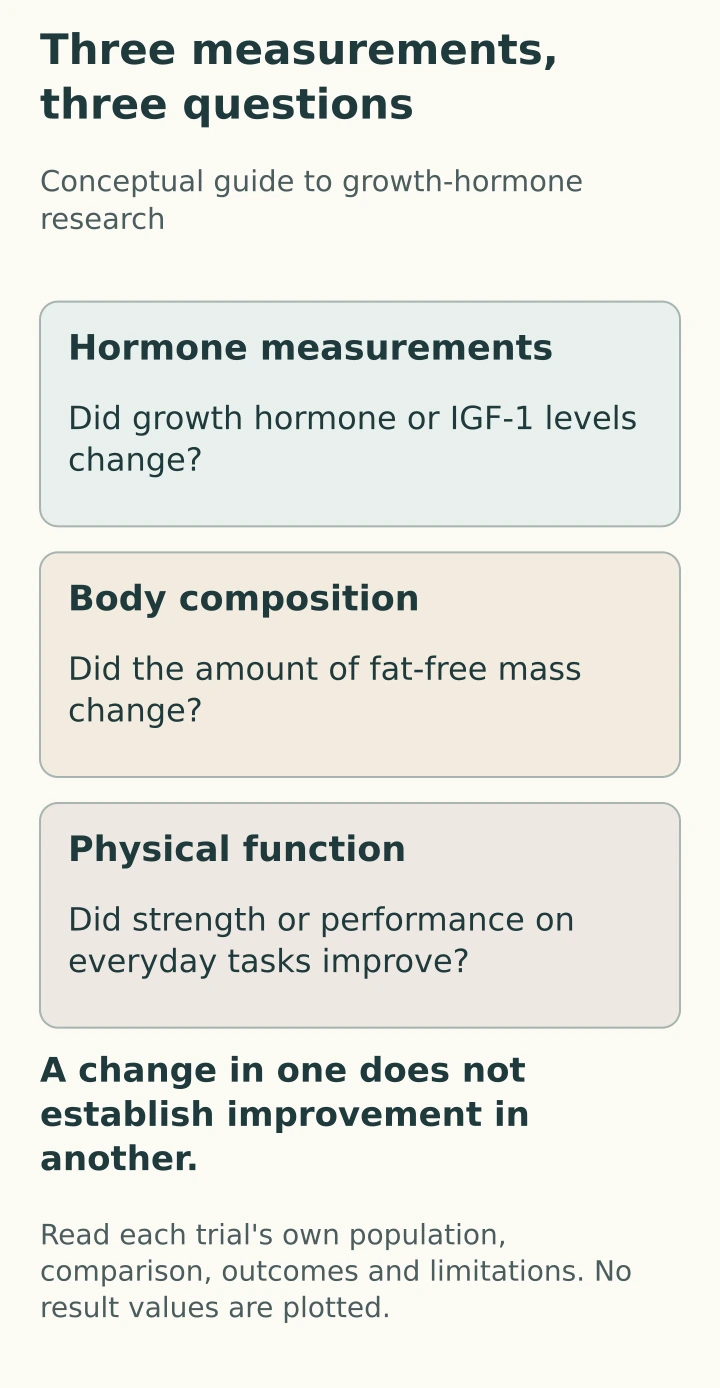
A biomarker is a measurable biological feature, such as the amount of IGF-1 in blood. It can show that a drug affected its intended system. Fat-free mass is a body-composition measurement; it includes water and other tissues as well as muscle.
Neither measurement directly tells us whether a person can climb stairs more easily or avoid disability. When a measurement is used as a stand-in for a health benefit, it is called a surrogate endpoint. The link between the two needs evidence. The MK-677 trial below shows why this distinction matters. [1]
How do these compounds change hormone release?
The pituitary gland, a small gland at the base of the brain, releases growth hormone in pulses. Growth hormone helps stimulate production of insulin-like growth factor 1, usually shortened to IGF-1. These signals affect growth, metabolism, and tissue maintenance. Their normal changes with age do not, by themselves, diagnose a hormone deficiency that needs treatment. [5]
Secretagogue simply means a substance that stimulates release. The compounds discussed here encourage growth hormone release through different receptors—the molecular receivers through which cells respond to signals.
Compound | What distinguishes it |
|---|---|
CJC-1295 | Mimics the hormone that tells the pituitary gland to release growth hormone. Early human trials tested a long-acting form; differently named forms cannot automatically inherit those results. [2] [9] |
Sermorelin | Another mimic of the hormone that triggers growth hormone release. It has earlier uses in diagnostic testing and treatment of children, and was tested in a small study of thinking abilities in older adults. [8] [11] |
Ipamorelin | A peptide, or short chain of protein building blocks, that acts through the receptor for the hormone ghrelin. Research after surgery concerns recovery of bowel function, a different goal from healthy aging. [6] |
Ibutamoren, or MK-677 | A drug taken by mouth that mimics the hormone ghrelin. It is not a peptide, despite sometimes appearing in the same discussion. [1] |
Capromorelin | A growth hormone stimulator taken by mouth, tested in older adults with mild limits on physical ability. Its results apply to that compound and group of people. [3] |
Tesamorelin | Mimics a signal that triggers growth hormone release. It has a specific approved use, with instructions that differ between product formulations. [7] [12] |
The practical point is to identify the exact compound, formulation, and intended use. A biological response shared by several drugs does not make their benefits or risks interchangeable. Combining drugs also introduces a separate question that evidence for either ingredient alone cannot answer.
What happened when researchers measured physical function?
Three trials illustrate the range of results. Each compared an individual drug with placebo, a treatment without the active drug; they were not direct comparisons between drugs.
Trial and participants | What improved | What limits the conclusion |
|---|---|---|
MK-677, 2008: 65 healthy adults aged 60–81 | Growth hormone, IGF-1, and fat-free mass increased at one year. | Strength and physical function did not significantly improve. Blood sugar rose and the body became less responsive to insulin. [1] |
Capromorelin, 2009: 395 adults aged 65–84 with mild functional limitations | Lean mass and a walking-balance test improved at six months; stair-climbing performance improved at twelve months. | The planned two-year trial stopped early under rules set in advance for judging the treatment’s effect. Fatigue, insomnia, and small adverse changes in glucose-related measures were reported. [3] |
MK-677 after hip fracture, 2011: 123 older patients | IGF-1 and a walking-speed score improved. | Stair-climbing power and several other functional measures did not significantly improve. Concern about a possible heart-failure risk led to early stopping. [4] |
In the healthy-adult MK-677 study, average fat-free mass rose by 1.1 kg with treatment and fell by 0.5 kg with placebo at one year. Fasting blood glucose rose by about 5 mg/dL with MK-677; participants also reported increased appetite, mild leg swelling, and muscle pain. The trial lasted two years and included switching between treatment and placebo. The second-year analyses were exploratory: they looked for possible patterns that would need further study. The number of participants and length of follow-up were insufficient to settle whether the drug improves physical abilities. The study did not demonstrate such a benefit, but could not rule one out. [1]
The capromorelin trial also needs to be understood in context. The walking test involved placing one foot directly in front of the other. The treatment groups, analyzed together, improved by 0.9 seconds compared with placebo at six months. That is a favorable test result, but the study does not establish whether it would translate into a noticeable daily-life benefit, less disability, or longer life. The trial's participants had mild limitations, whereas the MK-677 volunteers were relatively healthy; this may affect how much room there is to improve. Pfizer supported the capromorelin study, and company employment and financial relationships were disclosed. [3]
The hip-fracture study adds a distinct concern. Congestive heart failure means the heart is not pumping adequately for the body's needs. The signal that stopped this trial cannot provide a precise risk estimate for every potential user, but it matters when judging the treatment in vulnerable older patients. The US Food and Drug Administration (FDA) specifically identifies this finding as a concern for ibutamoren mesylate in its safety notice about drugs prepared for individual patients, known as compounded drugs. A higher IGF-1 result does not resolve it. [4] [10]
What do studies of CJC-1295, ipamorelin, and sermorelin show?
Two early CJC-1295 trials lasted 28 and 49 days and enrolled healthy adults aged 21–61. They demonstrated sustained increases in growth hormone and IGF-1 and reported no serious adverse reactions. Their main measurements concerned hormone exposure and how long the compound remained active, rather than falls, independence, or lifespan. Short studies cannot settle safety over years. [2]
Formulation matters here. DAC, or drug affinity complex, describes a modification intended to prolong action. FDA's compounding review distinguished several CJC-1295 forms, including forms with and without DAC. Its separate safety notice describes limited clinical data, concerns about immune reactions and how well the product’s properties are known, and reports of increased heart rate and a reaction involving widespread blood-vessel dilation. The name on a product is not enough to connect it to the material in a particular trial. [9] [10]
Ipamorelin was tested after bowel surgery in a trial that randomly assigned treatments and enrolled 117 patients; 114 were included in the main safety and efficacy analyses. It was given into a vein for up to seven days or until discharge. The time until patients could tolerate a standardized solid meal did not differ significantly from placebo, and neither did the other measures of treatment benefit. This Helsinn-supported trial does not establish benefit from long-term injections under the skin for healthy aging. The investigators described the short regimen as well tolerated. FDA’s safety notice also identifies serious adverse events, including death, reported during intravenous ipamorelin research, and inadequate safety information for certain other injection routes. An event during treatment does not, by itself, establish that the drug caused it. [6] [10]
Sermorelin has an encouraging but limited human cognition finding. A six-month trial randomly assigned 100 healthy adults aged 60–85 to sermorelin or placebo; 89 completed it. Treatment assignments were kept hidden during assessment, a method called blinding. Selected tests of problem solving and attention favored treatment; vocabulary and verbal fluency—the ability to bring words to mind—did not improve. The results came from people who completed the study. With several tests examined and only six months of follow-up, the findings leave uncertainty about a lasting benefit in everyday life. The trial did not establish prevention of dementia or preserved independence. The paper also describes two withdrawals likely related to the treatment protocol: an injection-site rash and a general feeling of being unwell. Serono supplied the study drug and placebo, and two authors disclosed relationships with the company. [11]
Sermorelin's approval history answers a different question. Earlier Geref products had US approvals for childhood growth hormone deficiency and diagnostic testing. Their approvals were withdrawn effective June 2009; in 2013, FDA determined that they had not been withdrawn for safety or effectiveness reasons. That history neither means the drug was removed as dangerous nor gives a current compounded preparation an approval for longevity. [8]
The sermorelin trial did not establish preserved independence or longer life. Studies of CJC-1295 and ipamorelin given separately cannot show whether their combination would provide those benefits. [2] [6] [11]
An approved use still has boundaries
The Egrifta SV and Egrifta WR tesamorelin labels specify reduction of excess abdominal fat in adults with HIV-associated lipodystrophy. They exclude weight-loss management and state that long-term cardiovascular safety has not been established. Important warnings concern elevated IGF-1, fluid retention, and difficulty controlling blood glucose. The products must not be used in people with active cancer. The March 2025 WR label also says WR and SV are not substitutable formulations. These details apply to the named US products. [7] [12]
Even the underlying aging biology resists a simple target. Reduced growth hormone signaling extends lifespan in some animal models, often involving lifelong genetic changes. That does not tell us to lower—or raise—the hormone in an older person. The question remains whether a defined treatment produces a worthwhile benefit with acceptable harms in the people who would receive it. [5]
Start with the ability you want to preserve
Concern about weakness, slower walking, memory, or one laboratory value can lead to very different clinical discussions. A useful first step is to identify the problem and what a meaningful improvement would look like.
Questions worth bringing to that discussion include:
What diagnosis would justify treatment, beyond a comparison with younger hormone levels?
Which study tested this exact compound and formulation in people like me?
Did participants feel or function better, and was the change large enough to matter?
How were glucose changes, fluid retention, and other harms assessed?
What outcome would show that treatment was worthwhile, and when would it be reassessed?
The most useful evidence connects a biological effect to something a person can actually gain. These studies show that the connection is possible to investigate—and cannot be assumed from a higher hormone level alone.
What remains uncertain
The studies tested different drugs and formulations, groups of people, ways of giving treatment, treatment lengths and outcomes. Several were small, short or stopped early. It remains uncertain whether long-term use for normal aging provides benefits that outweigh the harms, or whether commercially offered combinations help people stay independent. The approval and regulatory information applies to the United States.
References
- Nass R et al. Effects of an oral ghrelin mimetic on body composition and clinical outcomes in healthy older adults: a randomized trial. Annals of Internal Medicine, 2008.
- Teichman SL et al. Prolonged stimulation of growth hormone and insulin-like growth factor I secretion by CJC-1295, a long-acting analog of GH-releasing hormone, in healthy adults. Journal of Clinical Endocrinology & Metabolism, 2006.
- White HK et al. Effects of an oral growth hormone secretagogue in older adults. Journal of Clinical Endocrinology & Metabolism, 2009.
- Adunsky A et al. MK-0677 (ibutamoren mesylate) for the treatment of patients recovering from hip fracture: a multicenter, randomized, placebo-controlled phase IIb study. Archives of Gerontology and Geriatrics, 2011.
- Cappola AR et al. Hormones and aging: an Endocrine Society scientific statement. Journal of Clinical Endocrinology & Metabolism, 2023.
- Beck DE et al. Prospective, randomized, controlled, proof-of-concept study of the ghrelin mimetic ipamorelin for the management of postoperative ileus in bowel resection patients. International Journal of Colorectal Disease, 2014.
- Egrifta SV (tesamorelin) US prescribing information. Revised February 2024.
- US Food and Drug Administration. Determination that Geref (sermorelin acetate) was not withdrawn for reasons of safety or effectiveness. Federal Register, March 4, 2013.
- US Food and Drug Administration. December 4, 2024 meeting of the Pharmacy Compounding Advisory Committee.
- US Food and Drug Administration. Certain bulk drug substances for use in compounding that may present significant safety risks.
- Vitiello MV et al. Growth hormone releasing hormone improves the cognition of healthy older adults. Neurobiology of Aging, 2006.
- US Food and Drug Administration. Egrifta WR (tesamorelin) prescribing information. Revised March 2025.
Disclosure
Industry support or author relationships were reported in the capromorelin, ipamorelin, and sermorelin studies discussed here. Prepared with AI assistance.