
Growth-hormone stimulators: higher levels, mixed benefits
MK-677, CJC-1295, ipamorelin, sermorelin and capromorelin differ in their evidence for strength, mobility and cognition. In a 65-person trial, MK-677 increased fat-free mass without improving strength or function, while blood glucose rose. Other studies found narrower benefits. Healthy Longevity Clinic examines which results could support independence, and where hormonal changes leave the clinical question unanswered.
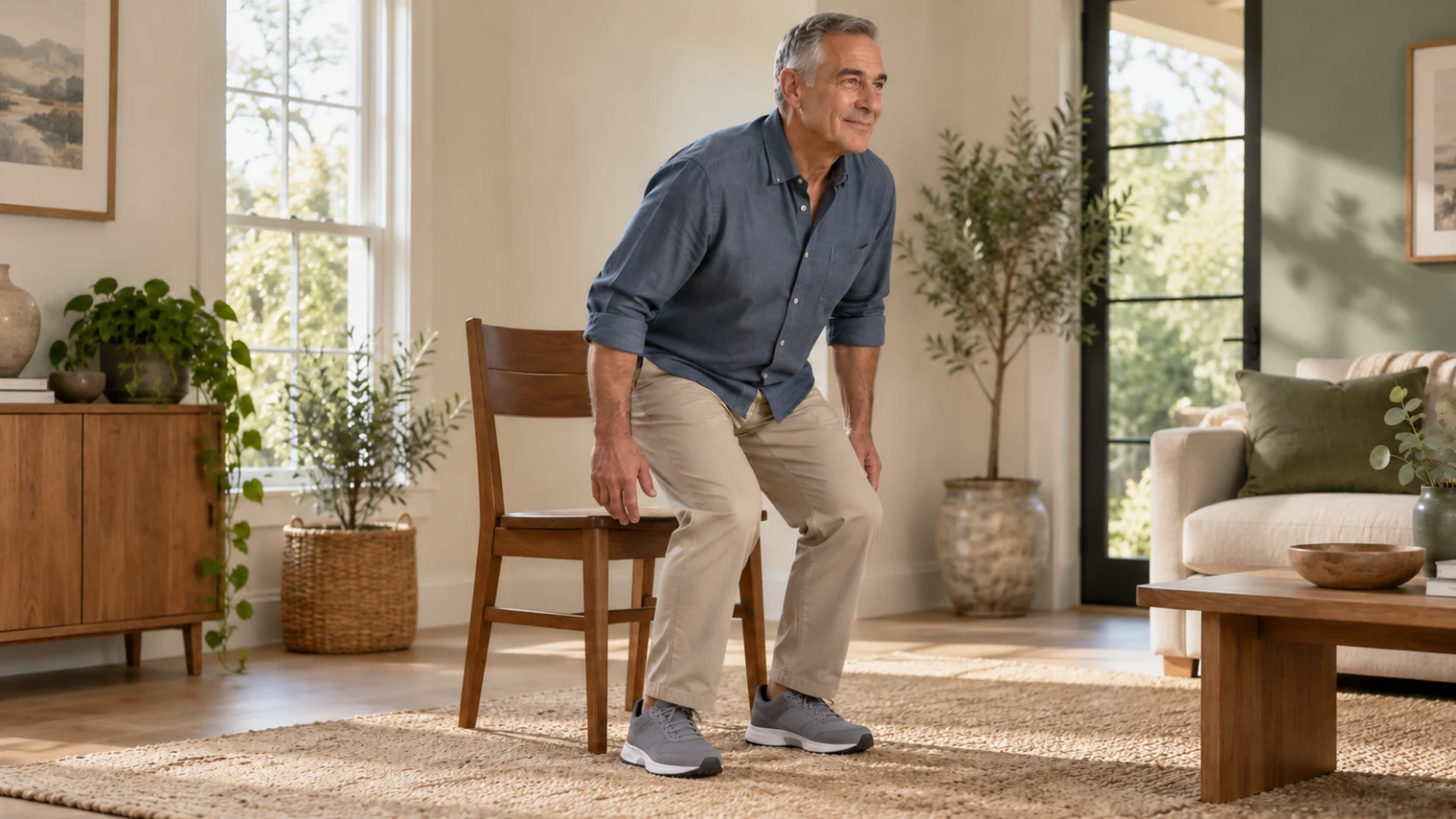
Evidence as of September 2026.
Shown: several drugs raise growth hormone or IGF-1; some increase lean tissue and improve selected physical or cognitive tests. [1] [2] [3] [11]
Not shown: a dependable treatment for normal aging, with preserved independence. [5]
What would matter next: larger, longer trials showing useful daily-life gains alongside acceptable glucose, fluid-retention and cardiovascular risks.
A kilogram of fat-free mass did not mean greater strength
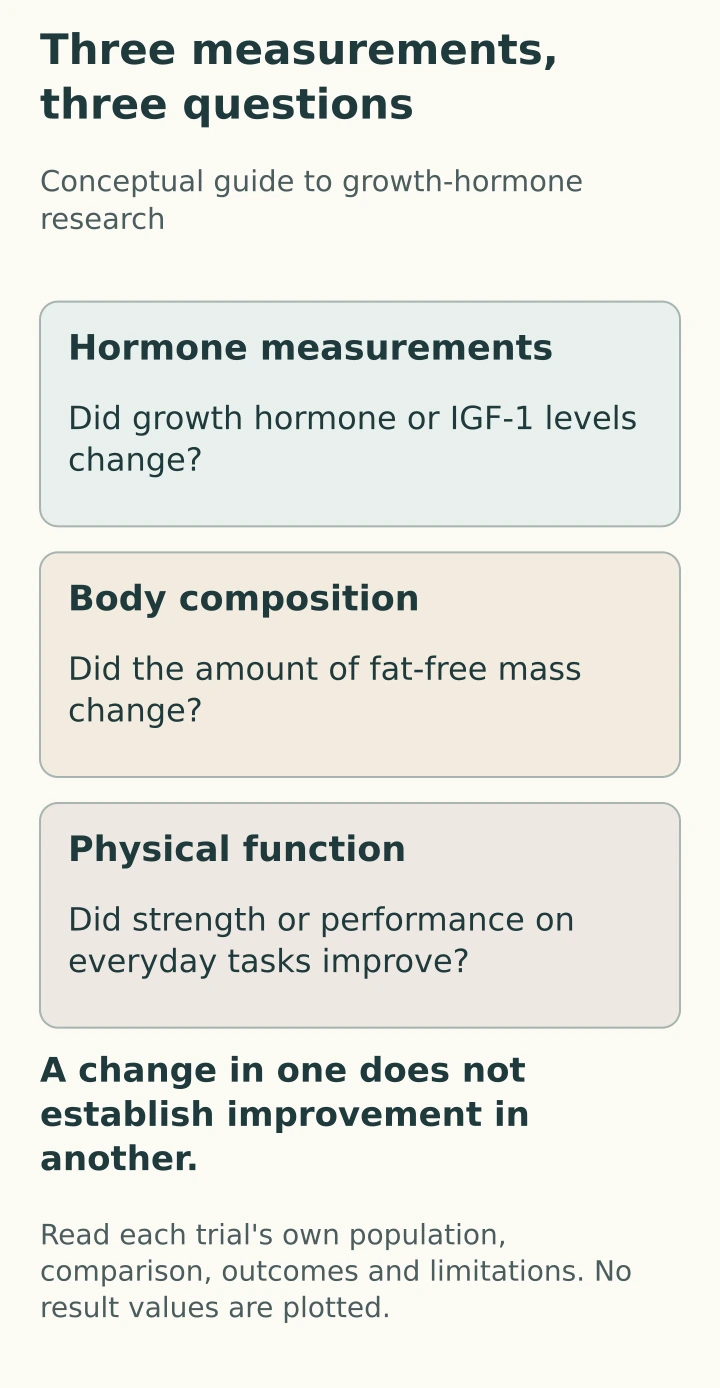
The clearest lesson comes from MK-677: the laboratory and body-composition changes did not translate into better strength or physical function in a trial of 65 healthy adults aged 60–81. At one year, fat-free mass rose by 1.1 kg with treatment and fell by 0.5 kg with placebo. Fasting glucose rose by about 5 mg/dL with MK-677, and insulin sensitivity worsened. [1]
Fat-free mass includes water and other tissues as well as muscle. IGF-1 is a blood marker of hormone-system activity. Neither directly measures whether someone climbs stairs more easily or stays independent. The trial ran for two years with treatment switching; second-year analyses were exploratory, and its size could not rule out every possible functional benefit. [1]
What did the main trials find?
The results are mixed, so “function never improves” would be as misleading as promising rejuvenation.
Drug and study | Benefit signal | Limit or harm |
|---|---|---|
MK-677, 65 healthy older adults, 2008 | Fat-free mass improved | Strength/function: no clear gain; glucose increased [1] |
Capromorelin, 395 older adults, 2009 | Walking-balance test: 0.9-second gain at six months | Daily-life importance uncertain; trial stopped early [3] |
MK-677, 123 hip-fracture patients, 2011 | Walking-speed score improved | Several other tests did not; heart-failure signal [4] |
Sermorelin, 100 older adults, six months | Selected attention/problem-solving tests improved | No vocabulary/fluency gain; lasting benefit unknown [11] |
Capromorelin also improved lean mass at six months and stair performance at twelve months. The planned two-year study stopped under preset rules for evaluating the effect. Fatigue, insomnia and small unfavorable glucose-related changes were reported. Pfizer supported it and relevant relationships were disclosed. The participants had mild functional limitations, unlike the relatively healthy MK-677 volunteers. [3]
The hip-fracture MK-677 study stopped because of concern about possible congestive heart failure, in which the heart cannot pump adequately for the body’s needs. The signal does not provide a precise risk for every user, but FDA specifically cites it as a concern. [4] [10]
Are these all the same kind of drug?
No. A growth-hormone secretagogue is simply a substance that stimulates release of the hormone; the drugs act through different signals and have different evidence.
CJC-1295, sermorelin and tesamorelin mimic a signal that tells the pituitary gland, at the base of the brain, to release growth hormone. Ipamorelin acts through the receptor for ghrelin. MK-677, also called ibutamoren, is an oral ghrelin mimic and is not a peptide. Capromorelin is another oral stimulator. Results for one compound do not establish the effects of a combination. [1] [2] [3] [6] [7] [11]
What do CJC-1295, ipamorelin and sermorelin show?
Each has a narrower clinical record than the broad healthy-aging claims suggest.
Two CJC-1295 studies lasting 28 and 49 days in adults aged 21–61 showed sustained hormone increases and no serious adverse reactions. They measured hormone exposure, not falls or independence. The long-acting modification, DAC, matters: FDA distinguishes forms with and without it. FDA’s safety notice also describes limited data, immune-reaction concerns, increased heart rate and a reaction involving widespread vessel dilation. [2] [9] [10]
Ipamorelin was given intravenously after bowel surgery in a trial enrolling 117 people, with 114 in the main analyses. It did not significantly shorten time to tolerating a solid meal. The investigators described the short regimen as well tolerated, but FDA also notes serious events, including death, reported during intravenous research. An event during treatment does not by itself prove causation. This Helsinn-supported study does not establish long-term healthy-aging benefit from injections under the skin. [6] [10]
Sermorelin’s six-month cognition trial had 89 completers from 100 randomized adults aged 60–85. Some tests improved, but several tests were examined and the analysis used completers. Two withdrawals were likely related to the protocol: a rash at the injection site and feeling unwell. Serono supplied drug and placebo, and author relationships were disclosed. The study did not demonstrate dementia prevention. [11]
What is tesamorelin actually approved for?
The US approval is for excess abdominal fat in adults with HIV-associated lipodystrophy, a specific disorder of fat distribution. It is not a general weight-loss or longevity indication. [7] [12]
Egrifta SV and WR labels state that long-term cardiovascular safety is unestablished, warn about raised IGF-1, fluid retention and glucose control, and prohibit use in active cancer. The March 2025 WR label says WR and SV are not substitutable formulations. Sermorelin’s historical Geref approvals were withdrawn in 2009; FDA’s 2013 finding that withdrawal was not for safety or effectiveness does not approve current compounded products for longevity. [7] [8] [12]
What should we watch next?
Future studies need to connect hormone effects to abilities people value and measure harms over sufficient time.
Function: confirmation of meaningful mobility or cognitive gains, beyond the mixed trials reported in 2008–2011 and the six-month sermorelin study. [1] [3] [4] [11]
Safety: longer glucose and cardiovascular follow-up, especially after the hip-fracture heart-failure signal. [4] [10]
Exact formulations: studies of the actual compound or combination proposed, rather than extrapolation from a related product. [2] [9]
How Healthy Longevity Clinic experts evaluate the evidence
For Healthy Longevity Clinic, preserving the ability to rise from a chair, climb stairs and remain independent matters more than restoring a hormone number to a younger range. This is why the MK-677 result is instructive: more fat-free mass did not bring better strength or function, while blood glucose rose.
We also retain the positive findings from other trials. Dismissing them would be as unhelpful as ignoring the harms. The clinical question is whether a particular drug delivers a worthwhile improvement for a defined person, over a useful period, with an acceptable safety balance. A narrow approved use such as tesamorelin's does not answer that question for normal aging.
The practical starting point is the ability someone wants to preserve and the cause of any decline. Even the underlying biology resists a simple “more is better” explanation: reduced growth-hormone signaling extends life in some animal models with lifelong genetic changes. Those models do not tell an older person to raise or lower their hormone level. [5]
Three questions for a treatment discussion
Which diagnosis and daily-life difficulty justify treatment beyond a lower hormone level?
Did a trial of this exact drug improve that difficulty in people like me?
How were glucose, swelling and cardiovascular problems tracked, and did the benefits outweigh them?
Frequently asked questions
Does MK-677 build muscle and strength?
It increased fat-free mass in the cited healthy-older-adult trial, but that measure includes more than muscle. Strength and physical function did not significantly improve. [1]
Do CJC-1295 and ipamorelin slow aging?
The studies described here do not establish that, individually or together. Short hormone studies and postoperative bowel-recovery research do not demonstrate preserved independence. [2] [6]
Does sermorelin prevent dementia?
No such benefit was established. Selected cognitive-test improvements over six months require confirmation and are not dementia-prevention results. [11]
What remains uncertain
The trials involve different drugs, formulations and patient groups, with short follow-up, early stopping or exploratory analyses. A favorable test result does not establish preserved independence or dementia prevention. Separate-drug results do not establish the effects of combinations.
References
- Nass R et al. Effects of an oral ghrelin mimetic on body composition and clinical outcomes in healthy older adults: a randomized trial. Annals of Internal Medicine, 2008.
- Teichman SL et al. Prolonged stimulation of growth hormone and insulin-like growth factor I secretion by CJC-1295, a long-acting analog of GH-releasing hormone, in healthy adults. Journal of Clinical Endocrinology & Metabolism, 2006.
- White HK et al. Effects of an oral growth hormone secretagogue in older adults. Journal of Clinical Endocrinology & Metabolism, 2009.
- Adunsky A et al. MK-0677 (ibutamoren mesylate) for the treatment of patients recovering from hip fracture: a multicenter, randomized, placebo-controlled phase IIb study. Archives of Gerontology and Geriatrics, 2011.
- Cappola AR et al. Hormones and aging: an Endocrine Society scientific statement. Journal of Clinical Endocrinology & Metabolism, 2023.
- Beck DE et al. Prospective, randomized, controlled, proof-of-concept study of the ghrelin mimetic ipamorelin for the management of postoperative ileus in bowel resection patients. International Journal of Colorectal Disease, 2014.
- Egrifta SV (tesamorelin) US prescribing information. Revised February 2024.
- US Food and Drug Administration. Determination that Geref (sermorelin acetate) was not withdrawn for reasons of safety or effectiveness. Federal Register, March 4, 2013.
- US Food and Drug Administration. December 4, 2024 meeting of the Pharmacy Compounding Advisory Committee.
- US Food and Drug Administration. Certain bulk drug substances for use in compounding that may present significant safety risks.
- Vitiello MV et al. Growth hormone releasing hormone improves the cognition of healthy older adults. Neurobiology of Aging, 2006.
- US Food and Drug Administration. Egrifta WR (tesamorelin) prescribing information. Revised March 2025.
Disclosure
Industry support or author relationships were reported in the capromorelin, ipamorelin, and sermorelin studies discussed here. Prepared with AI assistance.