
Thymosin alpha-1: can changing immunity improve healthy aging?
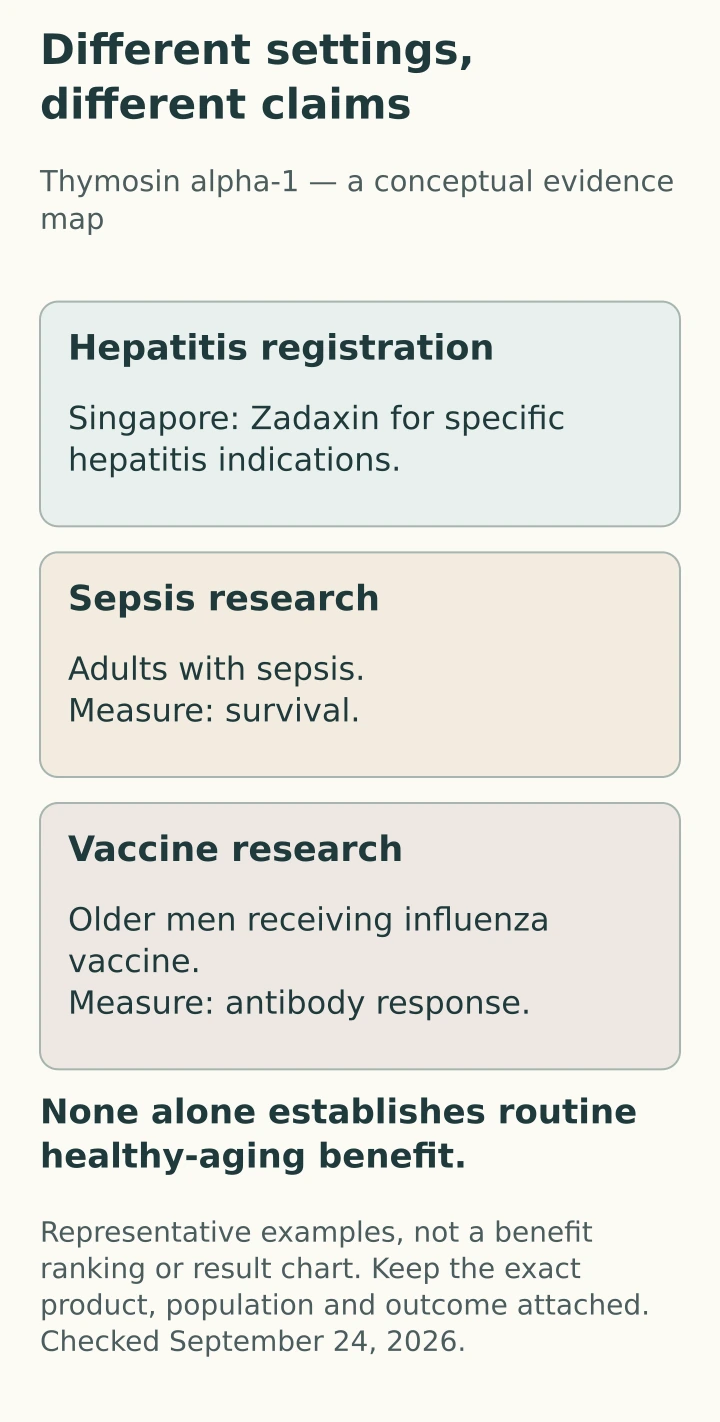
Thymosin alpha-1 has been studied in people with serious infections and in older adults receiving vaccines. Some studies found changes in immune responses, but a large trial in sepsis—a life-threatening response to infection—found no clear survival benefit. A registered use for hepatitis, or liver inflammation, in Singapore also does not establish a healthy-aging benefit. The useful question is which immune response changes, in whom, and whether that change helps people stay well.

Thymosin alpha-1 has a substantial clinical research history. It should be evaluated through that history, including the results that disappoint. An antibody measurement after vaccination, recovery from critical illness, and years of independent life answer different questions. Evidence for one cannot simply stand in for another. [3] [4] [6]
The commercial and medical context matters too. Zadaxin is a finished medicine containing thymosin alpha-1. Singapore's official formulary registers it as a prescription product for specified chronic hepatitis B and C uses and names SciClone as its license holder. This establishes a particular product's status in Singapore; it does not establish US approval, current stock, or a reason for a generally healthy person to take it. [2]
What does “immunomodulator” mean?
The immune system has many jobs: recognizing a threat, activating the right cells, and controlling the response afterward. An immunomodulator changes parts of that response. Calling it an “immune booster” leaves out which part changes and whether the change is useful.
Thymosin alpha-1 is being investigated for effects on immune-cell signaling, including cells that help present a threat to other immune cells. Some proposed mechanisms stimulate responses; others may help restrain inflammation. These mechanisms provide reasons to test a treatment. They do not establish protection against illness. [1]
First, identify the molecule and the intended treatment
Thymosin alpha-1, often shortened to Ta1, is a peptide: a short chain of amino acids, the building blocks of proteins. It contains 28 amino acids. Thymalfasin is the chemically synthesized form. A finished medicine, a bulk ingredient, and a product sold under the peptide's name can differ in formulation and manufacturing controls. The US Food and Drug Administration (FDA) has also assessed two chemical forms separately: the free base and the acetate salt. [1]
The name should not be confused with thymosin beta-4, the fragment commonly called TB-500, or extracts made from thymus tissue. Those are different materials. Nor does the association with the thymus establish that injecting this peptide regenerates that organ. [1] [7]
Keeping the exact preparation visible helps answer the central question: did the intervention tested in a study produce a worthwhile benefit for the people who received it?
Sepsis: an early signal faced a larger test
Sepsis is a life-threatening response to infection in which organs stop working properly. It is very different from ordinary aging. Its trials nevertheless provide an important lesson about how an encouraging result becomes more reliable—or less convincing—when tested in a larger study. [4]
Study | What the trial found | How to read it |
|---|---|---|
ETASS, 2013: 361 analyzed patients with severe sepsis in six Chinese intensive care units | Death by day 28 occurred in 26.0% of the thymosin alpha-1 group and 35.0% of controls. An immune-cell marker also improved. | The mortality comparison was sensitive to the statistical method, and treating physicians knew who received which treatment. It was an encouraging but uncertain result. [3] |
TESTS, 2025: 1,106 patients randomly assigned to treatment groups at 22 Chinese centers; 1,089 in the main analysis | Death by day 28 occurred in 23.4% of the thymosin alpha-1 group and 24.1% of the group given placebo, a treatment without the active drug. | In this larger trial, patients and clinicians did not know which treatment each patient received. It found no clear reduction in deaths. The figures follow the published correction. [4] [5] |
In ETASS, the simple comparison of the proportions who died did not reach the conventional threshold for statistical significance. A separate analysis that also considered when deaths occurred narrowly crossed that threshold. Baseline differences between groups further complicated interpretation. This is why the 26% versus 35% result should not be presented as an established reduction in deaths. A change in the immune marker HLA-DR on monocytes, a type of white blood cell, could not settle the survival question. [3]
For TESTS, the corrected hazard ratio was 0.97, with a 95% confidence interval of 0.76–1.24. The hazard ratio compares the rate of death over follow-up; 1 means no difference. The interval includes both lower and higher rates with treatment. It therefore does not show a clear benefit, although it cannot exclude every smaller effect. [4] [5]
A May 2025 correction explains that the original report used some outdated database entries. Survival and immune-cell data were corrected, and the article was updated. This was a correction, not a retraction, and it did not change the overall interpretation into a positive survival result. [5]
Safety needs the same care. After a seven-day treatment course, overall adverse-event frequencies were similar during 90 days of follow-up. Analyses by age, planned before the results were known, raised concern about possible harm below age 60, while the older subgroup did not show a confirmed survival benefit. A later analysis took account of differences in treatment to support failing organs before thymosin alpha-1 was given. This weakened the concern in younger patients, but the analysis was exploratory. These subgroup findings need confirmation and do not establish the effects of repeated use over years. [4]
TESTS received university and regional research funding as well as SciClone support. Several authors disclosed company grants or consulting relationships. The paper states that funders did not direct its design, data collection, interpretation, or manuscript preparation. These relationships are relevant context, including when the result is negative. [4]
Older-adult vaccine research asks a different question
There is human research beyond intensive care. In a 1989 trial, 90 men aged 65–99 were randomly assigned to thymosin alpha-1 or placebo alongside influenza vaccination, with treatment assignments kept hidden; samples from 85 were analyzed. Investigators reported a greater antibody response at six weeks, with the difference attributed to men aged 77 and older. The study found no difference between treatment groups among men aged 65–76. No toxicity was observed in either group. [6]
This is evidence worth recognizing. It does not, however, establish fewer hospitalizations or longer life. The laboratory test measured antibody binding; it did not directly establish how well those antibodies protected against infection. FDA's later review of vaccine studies described studies intended to explore possible effects, inconsistent findings, and limits in the laboratory tests and health outcomes measured. [1]
The distinction matters because a vaccine add-on has to earn its place through comparison with the same vaccine given without it. A better laboratory response may be a useful intermediate finding, but patients ultimately need to know whether illness is less likely or less severe.
A 2023 preliminary report studied a different high-risk group: 194 people receiving hemodialysis, a treatment that filters the blood when the kidneys have failed. They were randomized to thymalfasin or a control group without it. The authors reported three deaths in the treated group and seven in controls, but explicitly said follow-up and the planned efficacy analysis were incomplete. Vaccinations occurred at different times, and the study lacked a placebo. The finding therefore cannot establish COVID-19 prevention or a benefit for generally healthy older adults. [11]
The dialysis pilot acknowledged SciClone funding, including payments to Clinical Research Consultants and consulting fees to lead author Cynthia Tuthill. It also carried a separate declaration of no known competing interests. Both statements are part of the published report. [11]
A Houston Methodist trial is designed to test thymalfasin before COVID-19 booster vaccination in adults aged 65 and older. This phase 1 study, an early stage of human research, plans to enroll 75 participants. It randomly assigns treatments, and participants and researchers know who receives which treatment. Its main aim is to assess safety; it also measures antibodies and responses of T cells, a type of immune cell. Its registry entry describes the study plan rather than results. [8] [12]
That is a clearly defined research question, not a demonstrated prevention strategy. Even a favorable immune-response result would need careful interpretation before claiming that the add-on reduces serious illness.
Registration and product safety have their own boundaries
The Singapore Zadaxin entry specifies chronic hepatitis B treatment alone or with interferon, and chronic hepatitis C treatment with interferon. It does not list healthy aging. Registration also does not tell a patient which hepatitis treatment is currently preferred; that requires disease-specific clinical assessment. [2]
In the United States, FDA's November 2024 assessment stated that neither thymosin alpha-1 free base nor its acetate form was a component of an FDA-approved drug. The December 2024 advisory committee subsequently voted 17–4 against adding each form to the 503A list of ingredients for compounded drugs, which are prepared for individual patients. These were advisory votes about ingredients for compounded preparations, not finished-medicine approval decisions. [1] [10]
Other regulatory terms require the same distinction. An orphan-drug designation is a development incentive, not permission to market a medicine. A compounding nomination or a change in an ingredient's regulatory category also does not establish the safety and effectiveness of a finished product for healthy aging. [1]
FDA's assessment also describes the observed clinical safety record: many studies reported no significant adverse events attributed to thymosin alpha-1, while the most common reported reactions were irritation, redness, or discomfort at the injection site. The agency found the vaccine safety evidence insufficient for a dependable assessment of that use. [1]
FDA's safety notice describes concerns about proposed compounded thymosin alpha-1 preparations, including peptide impurities, difficulty establishing the active ingredient’s exact properties, and unwanted immune responses. Peptide aggregation—molecules collecting into larger clusters—can also affect how the immune system responds to a preparation. These concerns do not quantify how often harm would occur, but a study of another formulation does not make them disappear. [1] [7]
The registered Singapore product also has patient-specific restrictions. Its official information says it must not be used by people who are allergic to the product. It must also not be used when the immune system is deliberately suppressed, such as after an organ transplant, unless potential benefits clearly outweigh the risks. An intervention intended to alter immunity may conflict with the reason another treatment is suppressing it. [2]
Short studies and reports of few adverse effects cannot establish long-term safety for healthy users. The exact medicine, the person's illness, the other treatments they receive, and the duration of exposure all belong in that assessment.
What would make a healthy-aging claim convincing?
For infection prevention, a useful trial would measure confirmed infections, severity, hospital care, recovery, and harms. A broader healthy-aging claim would need longer follow-up and outcomes such as preserved function. Researchers would also need a clear comparison group and independent confirmation using the same preparation.
When considering a claim about thymosin alpha-1, ask:
Was the study about a specific disease, a vaccine response, or routine prevention in healthy people?
Did the researchers measure illness and recovery, or only an immune marker?
Was the result from a completed controlled trial, an exploratory subgroup, or a preliminary report?
Was the exact preparation the same, and what safety follow-up was available?
For concerns about immune health now, reviewing vaccination needs and established preventive care with a clinician is a practical starting point. NIH emphasizes keeping older adults' vaccinations current; the appropriate choices depend on age, medical conditions, and current guidance. Recurrent or unusual infections deserve assessment of the underlying problem. [9]
Thymosin alpha-1 remains a legitimate subject of clinical research. Its value for healthy aging will depend on showing that a defined intervention helps people—not simply that it changes an immune measurement.
What remains uncertain
The studies involved different groups of people, preparations, treatment lengths and health outcomes. Results in severely ill patients may not apply to healthy older adults. It is uncertain whether changes in antibodies lead to fewer or milder infections, or whether repeated use over years is safe. Approval and safety information must be considered separately for the United States and the specified Singapore product.
References
- US Food and Drug Administration. Thymosin alpha-1-related bulk drug substances: briefing document for the December 4, 2024 Pharmacy Compounding Advisory Committee. Assessment dated November 15, 2024.
- Singapore National Drug Formulary. Zadaxin injection: registered product information. Updated September 16, 2026.
- Wu J et al. The efficacy of thymosin alpha 1 for severe sepsis (ETASS): a multicenter, single-blind, randomized and controlled trial. Critical Care, 2013.
- Wu J et al. The efficacy and safety of thymosin α1 for sepsis (TESTS): multicentre, double blinded, randomised, placebo controlled, phase 3 trial. BMJ, 2025. Corrected article.
- BMJ. Correction: The efficacy and safety of thymosin α1 for sepsis (TESTS). May 30, 2025.
- Gravenstein S et al. Augmentation of influenza antibody response in elderly men by thymosin alpha one: a double-blind placebo-controlled clinical study. Journal of the American Geriatrics Society, 1989.
- US Food and Drug Administration. Certain bulk drug substances for use in compounding that may present significant safety risks.
- Houston Methodist. Thymalfasin as an enhancer of vaccine response among older adults receiving booster doses of COVID-19 vaccine.
- National Institutes of Health. Vaccinations and older adults. NIH News in Health, October 2022.
- US Food and Drug Administration. Final summary minutes, Pharmacy Compounding Advisory Committee, December 4, 2024. Approved February 21, 2025.
- Tuthill CW et al. A pilot trial of thymalfasin to prevent COVID-19 infection and morbidities in renal dialysis patients: preliminary report. International Immunopharmacology, 2023.
- ClinicalTrials.gov. Thymalfasin as an enhancer of vaccine response among older adults receiving booster doses of COVID-19 vaccine. Record updated July 16, 2026.
Disclosure
The TESTS trial and dialysis pilot reported SciClone support and commercial relationships, described in the article. Prepared with AI assistance.