
What does a VO₂ test tell you that a fitness watch cannot?
Your watch can give you a convenient estimate of fitness. A laboratory VO₂ test goes further by measuring oxygen use while you exercise and showing how your heart, lungs and muscles respond as the effort rises. That fuller picture can help shape training or investigate an exercise limitation. Here is what happens during the test and how to make sense of the result.
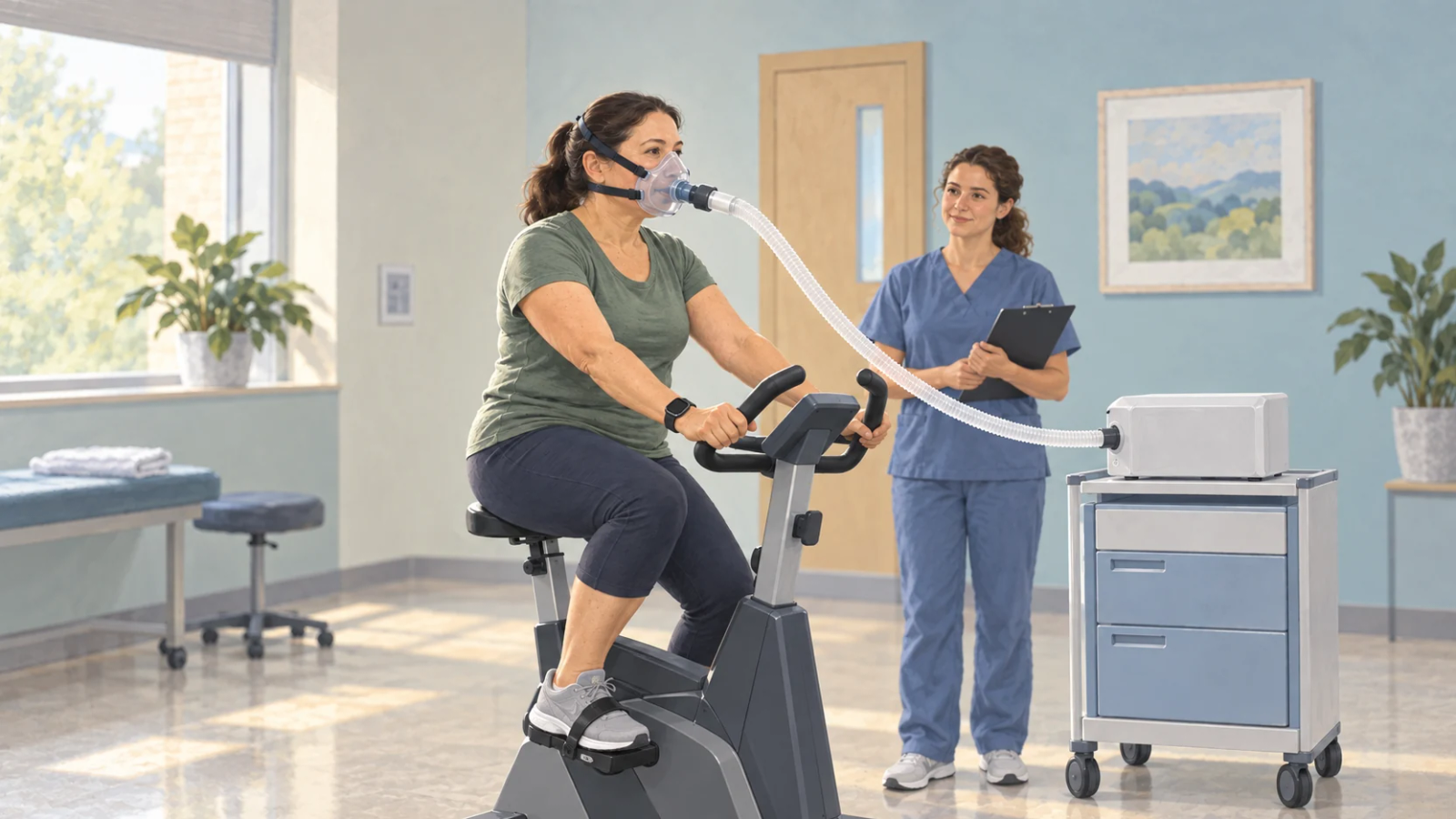
A walk feels harder than it used to. Or your training is going well, but the fitness number on your watch barely moves. Both experiences raise an interesting question: what is happening when your body meets a physical challenge?
A watch estimates fitness using signals such as heart rate and movement. Cardiopulmonary exercise testing—CPET for short—measures the gases you breathe during exercise. Alongside other measurements, it gives a fuller picture of how your body responds as the work becomes harder. [1] [2]
What VO₂ means
VO₂ is the amount of oxygen your body uses each minute. Your heart and lungs deliver oxygen, and your muscles use it to support activity. Measuring that process during exercise helps describe your capacity for sustained effort.
You will often see the result expressed per kilogram of body weight: mL/kg/min. A report may also give the total amount in liters per minute. “Peak VO₂” means the highest value reached during the test. Whether that represents a true maximum depends on the effort achieved and the rest of the response. [2] [3]
A watch does not sample your breathing gases. Its estimate can be convenient for following activity and starting a conversation, but it answers the question indirectly.
How close are watch estimates?
Two small studies published in 2026 compared Apple Watch Series 10 and Google Pixel Watch 3 estimates with treadmill testing that measured breathing gases. The Apple estimate was lower than the laboratory result on average. The Pixel average was much closer, yet individual readings still varied widely in both studies. [4] [5]
That is the useful lesson: an accurate average across a group does not guarantee an accurate estimate for you. These were separate studies of particular hardware and software, so they are not a direct contest between the watches.
Apple’s earlier manufacturer research reported more favorable average accuracy using a different reference method. Comparing such results requires knowing how each study was done. Nor should you “correct” your own watch by adding the average error from a paper; your difference could go in the other direction. [3] [4] [5]
Bring a watch trend to your clinician if it raises a question, along with the device model and any change in how you feel. A trend is useful context, but these studies did not establish how reliably the watches track each person’s improvement over many months.
What happens in the testing room
The team first checks that the test is suitable for you and explains the procedure. Tell them about recent illness, injury, symptoms and medicines. Follow their preparation instructions; do not stop prescribed treatment on your own.
You wear a mask or mouthpiece that collects information about airflow, oxygen and carbon dioxide. Clinical CPET commonly also monitors the heart’s electrical activity, blood pressure and blood oxygen. After a warm-up, the treadmill gets harder or the resistance on a stationary bike rises. The main exercise stage often lasts around 8–12 minutes, with preparation and recovery making the appointment longer. [1]
The team explains how to signal discomfort or ask to stop. Monitoring continues during recovery, and the results are reviewed afterward. Ask when you will discuss the report: the interpretation is an essential part of the service.
Services called “VO₂ testing” vary. A fitness measurement may not include the same monitoring or medical interpretation as a clinical investigation of breathlessness. Check which kind you are booking. [1] [2]
A simple example of reading the numbers
The following invented example illustrates the units; it is not a patient report or a training prescription.
Measurement | Example |
|---|---|
Exercise method | Stationary bike with increasing resistance |
Body weight | 80 kg |
Total peak oxygen use | 2.40 liters per minute |
Peak oxygen use per kilogram | 30 mL/kg/min |
Reason for stopping | Leg fatigue |
The relative value comes from dividing 2,400 milliliters by 80 kilograms. Now imagine the same oxygen use at a weight of 75 kilograms: the relative result would be 32 mL/kg/min. The number rose even though total oxygen use stayed the same.
This does not mean weight loss is the right goal. It shows why the clinician asks what changed—oxygen use, body weight, test method or the effort achieved—before interpreting a higher score. Leg fatigue also matters: it may have ended the test before a maximum could be established.
The useful information beyond one score
A clinical report looks at patterns: how breathing, heart rate and oxygen use change with workload, what symptoms occur and why you stop. These can help investigate an exercise limitation. A low peak value alone does not identify the cause. [2] [6]
The report may identify a ventilatory threshold, a change in breathing-gas patterns as effort increases. It can help inform exercise planning. It is not automatically the same as a default heart-rate zone on a watch. [6]
For follow-up, compare like with like. Bike and treadmill tests can produce different results, and changes in protocol or effort can affect the comparison. A useful review explains what has improved and how confidently it can be interpreted.
When the extra detail is useful
Clinical CPET can help investigate unexplained exercise limitation, assess selected people with heart or lung disease, or answer particular questions before treatment or surgery. A clinician should decide whether it is the right investigation. New symptoms deserve that assessment before you attempt a maximal effort on your own. [1] [2]
For a well person focused on fitness, the question is simpler: how will the result improve the exercise plan? A suitable test can provide a baseline or help make training more personal, provided someone explains how to use the findings.
At Healthy Longevity Clinic, we connect assessment with the ability a person wants to preserve or develop. Before arranging a VO₂ test, confirm the current location and availability, the level of supervision and who will explain the report. Our service information describes the assessment; individual clinic arrangements need confirmation. [8]
The most useful outcome is an understandable answer about your exercise response and a clear next step toward staying active.
What remains uncertain
The watch studies involved small groups of healthy adults and particular device and software versions. They did not establish accuracy for every user or long-term trend. The numerical example below is invented for teaching. A peak VO₂ value alone cannot diagnose the cause of a limitation or provide a complete health clearance.
References
- Cardiopulmonary Exercise Testing (CPET).
- ARTP statement on cardiopulmonary exercise testing 2021.
- Using Apple Watch to Estimate Cardio Fitness with VO₂ max.
- Accuracy of VO₂ max Estimates From Apple Watch Series 10.
- The accuracy of VO₂ max, heart rate and energy expenditure measurements from Google Pixel Watch 3.
- Practical guide to cardiopulmonary exercise testing in adults.
- Apple advances health and fitness capabilities using Apple Intelligence.
- VO₂ and cardiopulmonary exercise testing
Disclosure
Prepared with AI assistance. Healthy Longevity Clinic provides assessment services. Google funded the cited Pixel study; the authors reported no funder role in its conduct or publication decisions. The Series 10 study reported public research grants, while the historical Apple validation was supplied by the manufacturer.