
Whole-body MRI: what it finds and what follows
Whole-body MRI can discover an unsuspected cancer or another important abnormality. A review of ten studies involving 9,024 people without symptoms estimated roughly 16 confirmed cancers per 1,000 people screened. That is detection, not a count of lives saved. Scans can also trigger further tests for uncertain findings, and longer life from routine screening of well, average-risk adults has not been established.
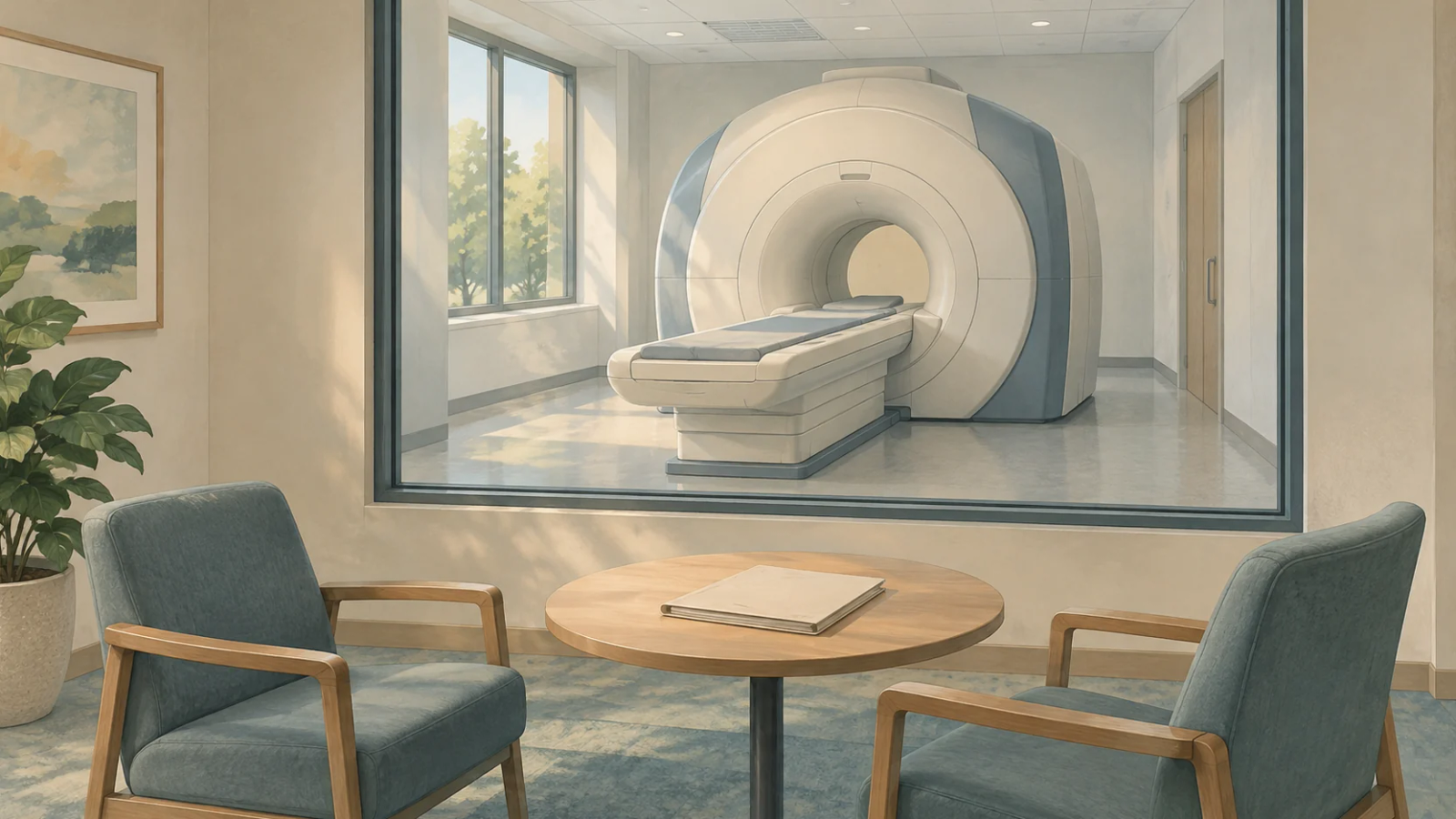
The decision includes both the scan and what may follow. Finding a treatable disease can matter greatly to an individual. So can uncertainty, repeated imaging or an invasive test for a finding that ultimately needs no treatment. Before scanning, it helps to know which question you want answered and who will guide the next decision. [1] [2] [5]
What the evidence shows
Shown: whole-body MRI detects some previously unsuspected cancers and other abnormalities without using ionizing radiation. It also has a defined role in surveillance for certain inherited cancer risks. [2] [3] [4] [6]
Not shown: the number of cancers detected does not establish that regular whole-body screening makes average-risk people live longer. There is no single reliable false-positive rate for every protocol and person. [1] [2] [7]
What would change the assessment: comparative evidence that offering screening reduces serious illness or deaths, with an acceptable burden of unnecessary investigations, treatment and cost. [9]
The reason for scanning changes the answer
If you have symptoms or an abnormal clinical result, you need a diagnostic assessment. A clinician selects imaging directed at the problem. A broad screening survey may not provide the detail needed to answer that question. [5]
A defined inherited condition that raises cancer risk is a different situation. GeneReviews recommends annual whole-body MRI as part of a broader specialist surveillance program for Li-Fraumeni syndrome. This applies to an unusually high-risk population. It does not establish an annual schedule for everyone else. A relative's cancer diagnosis can justify reviewing your family history, but does not by itself identify the right scan; risk assessment or genetic counseling may be the useful next step. [3]
If you feel well and are considering a general health check, the balance is less certain. The American College of Radiology's April 2023 statement found insufficient evidence to recommend total-body screening for people without symptoms, relevant risks or a concerning family history. It cited unproven life-extension benefit and unnecessary investigations. An official summary posted by the Royal Australian and New Zealand College of Radiologists in May 2026 also advised against screening asymptomatic people without a previously diagnosed cancer or cancer-predisposition syndrome. [1] [8]
“Whole-body” does not mean every possible disease
Magnetic resonance imaging (MRI) uses magnetic fields and radio waves to create images. Unlike CT, it does not use ionizing radiation. That is a real advantage, while the value of a screening program remains a separate question. [4]
Programs differ in the areas scanned, types of images, scan duration, use of contrast agents to make some structures clearer, and reporting. A broad survey without contrast is not equivalent to detailed examinations of every organ. One academic program described in 2026 covered the head and body to the mid-thigh and took about 45–55 minutes. Those are features of that program, not a standard for every scan. The article also described limits in assessing lung tissue and the possible need for targeted imaging. [5]
Ask which body regions and conditions the proposed protocol assesses well and what it may miss. A reassuring report means no concerning finding was identified within the examination's limits; it is not a permanent guarantee of health.
Cancer detection and additional findings are different results
Evidence | Confirmed cancer detection | What else matters |
|---|---|---|
Review of ten studies, 9,024 asymptomatic participants; online 2025, journal issue 2026 | Pooled detection rate 1.57%; 95% confidence interval 1.22%–2.03%. Rounded, about 16 per 1,000 screened. | Most studies had moderate to serious risk of bias. Long-term outcomes and cost-effectiveness evidence were lacking. [2] |
Retrospective study of 327 asymptomatic adults at four centers, March 2026 | Three confirmed malignant lesions; reported detection yield 0.9%. | 138 people, or 42.2%, had at least one finding rated 3 or higher on ONCO-RADS, a scale for reporting cancer-related findings. Of 237 findings in those categories, 232 were category 3, meaning likely benign. [5] [6] |
The review's range expresses statistical uncertainty around a pooled estimate. It is not your personal chance of cancer, and “16 per 1,000” is a rounded summary across studies, not a count of deaths prevented. Age, underlying risk, referral patterns, protocols and follow-up all affect detection. [2]
The smaller study illustrates why denominators matter. One person can have several findings. Its 138 people with category 3 or higher findings were not 138 cancer cases. Nor should every noncancer finding be called a false positive: a likely benign observation may be accurately described as such. The study looked back at reports; it was not a randomized comparison showing a survival benefit. [6]
Three Prenuvo employees challenged the review's description of its detection yield as modest in a published letter. They pointed to established screening programs and the opportunity to find cancers without existing screening pathways. That is a useful argument for further study. Similar detection percentages in different populations, however, cannot establish similar benefits or harms; the letter also called for studies that follow participants forward to assess whether screening improves care. [10]
Why earlier diagnosis does not always mean longer life
Suppose screening moves a diagnosis earlier but does not change when the person dies. Survival measured from diagnosis becomes longer, although life does not. This is lead-time bias. Screening also tends to find slower-growing disease, which can make detected cases look more favorable even before treatment is considered. [9]
The question is whether offering screening prevents serious illness or death overall, after accounting for harms. An early diagnosis may help a particular person, but detection alone cannot tell us the average benefit of offering the same scan to everyone. [9]
Four terms worth separating
Term | What it means | Why it matters |
|---|---|---|
Incidental finding | An unexpected observation on imaging | It may be harmless, uncertain or important. |
False positive | A finding raises concern for a condition that later testing does not confirm | Resolving the concern can still involve cost, anxiety or procedures. |
Overdiagnosis | A real condition is found that would not have caused harm during the person's lifetime | It can lead to treatment without a corresponding health benefit. |
False negative | Disease is present but the scan misses it | A clear scan cannot rule out every disease or dismiss later symptoms. |
Overdiagnosis concerns a real finding; it is different from a false alarm. These distinctions explain why counting abnormalities is not enough to assess a screening program. [1] [5] [7] [9]
A 2019 review included 12 studies and 5,373 people. Only six studies reported false positives, and the pooled estimate was highly uncertain. Verification of findings was incomplete, and negative scans were not systematically checked over the long term. Its figures cannot supply a precise probability of a false positive or missed disease for a modern individual scan. [7]
What happens after a finding?
Follow-up should reflect the appearance of the finding, symptoms, risk and previous imaging. A clearly benign observation may need no investigation. An uncertain one may call for comparison with an older scan, targeted ultrasound, dedicated MRI or CT, or imaging after an appropriate interval. A sufficiently suspicious finding may need specialist assessment and sometimes a biopsy—taking a tissue sample for examination. The scan alone will not always establish the diagnosis. [5] [7]
The useful questions are: what is the concern, how urgent is it, and what next step would reduce uncertainty? If monitoring is suggested, ask what change would trigger action. If a biopsy is suggested, ask how its result would change treatment.
A named clinician should be responsible for explaining the report, arranging appropriate follow-up and checking that it occurs. Previous imaging can help distinguish an unchanged finding from a new one. These safeguards make findings easier to manage, but they do not by themselves prove that screening improves outcomes. The 2026 radiologist-led program article describes how to organize care; it is not a trial showing fewer deaths. [5]
How Healthy Longevity Clinic experts evaluate the evidence
For someone hoping to find a dangerous disease while it is still treatable, the decisive comparison is between a justified screening strategy and its full chain of consequences. In the four-center study, three malignant lesions and 138 people with category 3 or higher findings describe different sides of that chain. Neither number alone settles whether screening is worthwhile for you. [6]
The first clinical decision is which situation applies: a symptom needing diagnosis, a defined inherited risk needing specialist surveillance, or general screening in someone who feels well. The next is whether the proposed scan and follow-up plan address that situation. Annual MRI in Li-Fraumeni surveillance should not be borrowed as the rationale for an annual package in an average-risk person. [1] [3]
A useful consultation therefore ends with a clear reason for testing, a plan for uncertain findings and a named clinician responsible for follow-up. Choosing not to add whole-body MRI is reasonable for a well person at average risk given the evidence described here. A change in that assessment would require stronger outcome comparisons showing that the benefits of screening outweigh its downstream harms. [1] [2] [9]
No ionizing radiation does not mean no risks
The MRI team needs to know about implanted devices, metal fragments and relevant previous procedures. The exact device and its MRI safety status must be checked. A device labeled MR Conditional is safe only under its specified conditions; the label is not blanket permission for any scan. [4]
Noise, lying still and claustrophobia can make the examination difficult. If contrast is proposed, ask why and discuss relevant medical history. Contrast agents and any sedation have their own risks, separate from the absence of ionizing radiation. [4]
The larger burden may occur afterward: appointments, repeat imaging, time away from work, out-of-pocket charges and uncertainty while a finding is clarified. The fee for the first scan may not cover this process. Before paying, consider both the possible diagnosis and the possibility of monitoring without an immediate definite answer.
Three questions for a consultation
Given my symptoms, family history and established screening needs, what specific question would this MRI answer, and what could it miss?
If it finds something uncertain, who will explain the result, coordinate follow-up and clarify likely additional costs?
What evidence supports repeating the scan at the proposed interval, and what finding would actually change my care?
Common questions
Does a normal scan replace recommended cancer screening?
Do not assume so. A broad MRI differs from targeted examinations and has limits. Review the screening recommended for your age, sex, history and location, and seek assessment of new symptoms even after a reassuring scan. [1] [5]
Does an abnormal report mean cancer?
No. An observation can be benign, uncertain or suspicious. Ask which description applies and why a particular follow-up is recommended. In the 327-person study, most category 3 or higher findings were category 3—likely benign. [5] [6]
Should everyone have one every year?
The cited evidence does not establish a yearly schedule for well, average-risk adults. Annual whole-body MRI belongs to specific specialist surveillance pathways, including Li-Fraumeni syndrome; a commercial annual package does not create the same evidence. [1] [3]
What if I already have a report?
Bring the complete report and relevant previous imaging to a clinician. Focus on findings that could change care, the urgency of any action and who will follow it through. A clear report is not a lifelong guarantee; an abnormal one is not automatically serious disease. [5] [7]
What remains uncertain
The studies differ in population, protocol, follow-up and definitions. The 327-person study was retrospective, and additional findings are not equivalent to cancer diagnoses or false positives. Incomplete verification limits false-positive and false-negative estimates. Follow-up can add procedures, cost and anxiety; existing US and Australia/New Zealand statements address the specific populations described.
References
- ACR Statement on Screening Total Body MRI.
- Whole-body MRI for opportunistic cancer detection in asymptomatic individuals: a systematic review and meta-analysis.
- Li-Fraumeni Syndrome.
- MRI: Benefits and Risks.
- How to implement a radiologist led whole-body MRI screening program.
- Whole-body magnetic resonance imaging for cancer screening in asymptomatic adults: a multicenter study.
- Whole-body MRI for preventive health screening: a systematic review of the literature.
- Whole Body MRI Screening in Low-Risk Patients Position Statement.
- What Cancer Screening Statistics Really Tell Us.
- Letter to the Editor: Clarifying interpretation of cancer detection utility from whole-body MRI.
Disclosure
Prepared with AI assistance. The authors of the cited letter favoring further investigation of whole-body MRI disclosed employment by Prenuvo. The cancer-detection meta-analysis reported no relevant company relationships. These disclosures should be considered alongside the study designs and findings.