
Young plasma and E5: what the rat studies actually show
Blood carries much more than oxygen and nutrients. Its liquid component, plasma, contains signals that help tissues communicate—and some may influence how we age. E5 research explores whether selected components from young pigs’ plasma can support healthier aging. Small rat studies have reported encouraging changes in function, molecular age and lifespan. The challenge now is to understand what drives those effects and whether they can become a useful treatment for people.
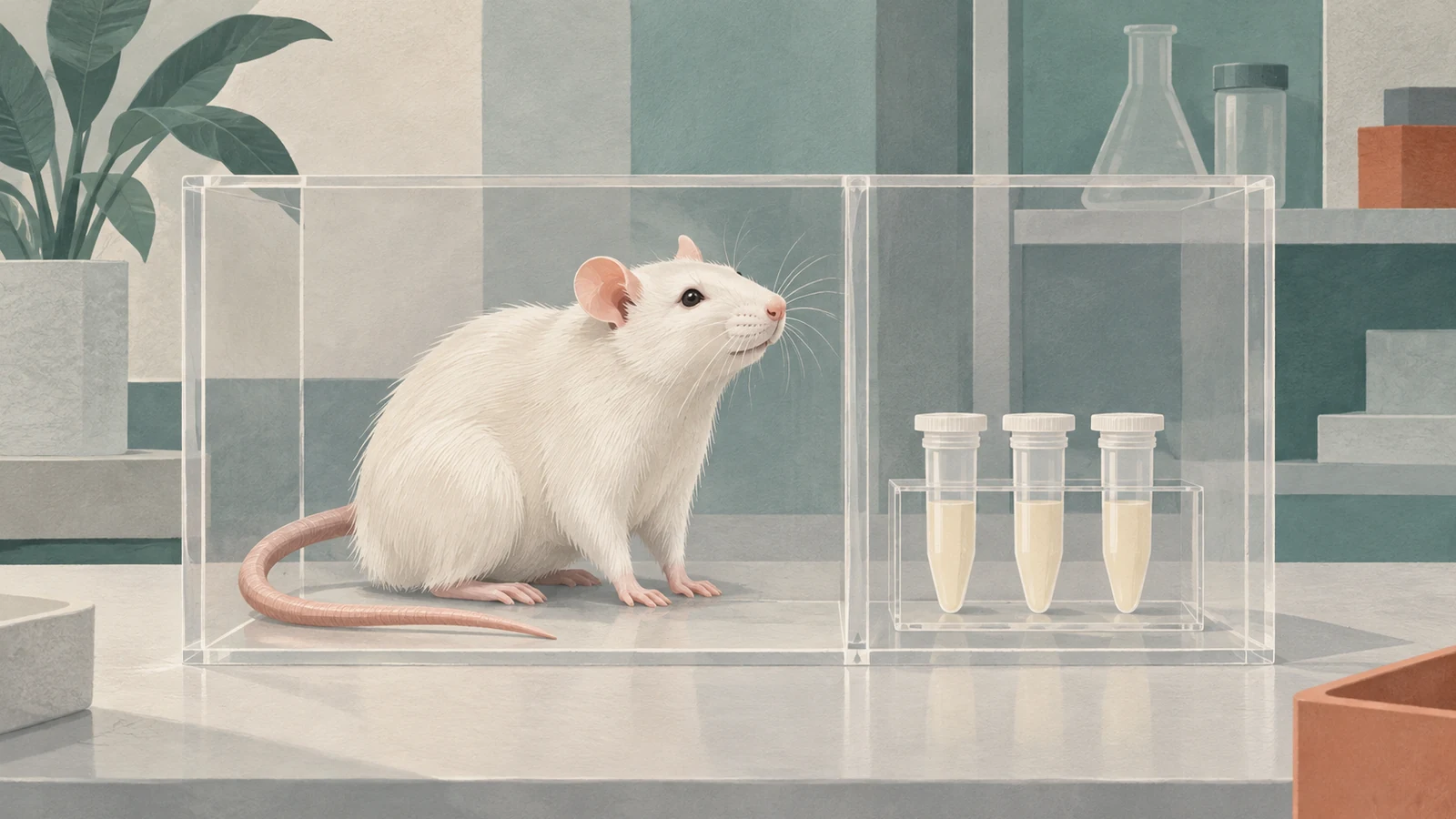
What if part of the biology of youth travels in the bloodstream? That question has inspired a growing field of aging research. Plasma, the liquid part of blood, carries proteins and other material between tissues. Researchers are exploring whether carefully selected components could help an older body function better. [1]
E5 is one approach to that idea. Developed by Yuvan Research, it is a concentrated fraction made from the plasma of young pigs. Early experiments in rats have produced a combination of findings worth following: changes in molecular patterns associated with age, improvements in some functional tests and, in a later study, longer survival. [1] [2]
Why this research matters to us
Yuvan Research is part of the Longevity Tech Fund portfolio, alongside Healthy Longevity Clinic. We are proud to support work that explores new ways to preserve health as we age. E5 is an example of the long path from a promising biological idea to a potential therapy, with animal findings helping define what should come next. [8]
What is in a plasma fraction?
A fraction is selected material taken from a larger mixture. E5 is made by processing plasma and concentrating part of it. The researchers describe tiny packages released by cells, called extracellular vesicles, together with other material. Exactly which components account for the effects is still being investigated. [1]
This is different from giving a transfusion of whole human plasma. It is also different from plasma exchange, which removes a person's plasma and replaces it with another fluid. E5 experiments add a processed product to the circulation. Understanding that basic difference makes the results much easier to follow.
The first studies: molecular age and everyday abilities
In the main experiment, older rats receiving E5 showed lower age estimates in several tissues, including blood, liver and heart. These estimates came from epigenetic clocks, which read chemical markings on DNA that tend to change with age. [1]
The researchers also reported favorable changes in inflammatory and blood measurements, as well as performance in a learning task. Additional experiments examined grip strength. This combination is interesting because it connects molecular changes with things an animal can do, rather than relying on a single test result.
The clock findings need to be understood as measurements of biological patterns. They do not mean that every part of an animal became younger by the same amount. Different clocks gave different strengths of evidence in a follow-up experiment, and the main comparison involved only six treated older rats and six older controls. The results invite larger studies to establish how consistent the effects are. [1]
A later study followed the rats for life
The September 2024 Aging Cell paper added a more direct outcome. Sixteen older female rats received repeated courses of E5 or saline, with eight animals in each group. The E5 group lived an average of about 40.7 months, compared with 37.1 months in the control group—a difference of roughly three and a half months. [2]
This matters because lifespan was actually followed. It takes the research beyond a change in an aging-clock estimate. The study was still small and involved one strain of female rats, so repeating the work in larger groups is important. The result is a reason for further research, rather than a forecast of how many years a person might gain.
Another question remains open: how much does the donor's age matter? The E5 studies compared the product with saline, not with an equivalent fraction from older pigs. That comparison can show an effect of the product, but a separate experiment is needed to identify a special contribution from youthful plasma. [1] [2]
What plasma research in people tells us
Human studies are exploring related ideas using different products. The small PLASMA study investigated young human plasma in people with Alzheimer's dementia, focusing on whether treatment was feasible and tolerated. It helped establish practical experience, while leaving the question of meaningful cognitive benefit open. [3]
A separate trial tested a human plasma protein fraction called GRF6021 around hip or knee replacement. It changed immune and inflammatory measurements, but did not show a clear advantage in recovery from pain or fatigue. This helps researchers understand which biological effects need to be connected to a benefit patients can feel. [9]
A 2026 Norwegian pilot examined young-donor plasma exchange in 12 people with mild cognitive impairment and Alzheimer's-related markers. It was a safety and feasibility study without an untreated comparison group. All participants experienced at least one adverse event; hives interrupted treatment in three, and two serious events were judged unlikely to be related to the procedure. These experiences underline the need for careful monitoring as the field develops. [4]
These studies add to our understanding of plasma-based approaches, but they did not test E5. The pig-derived fraction needs its own human studies to establish benefits, dosing and safety.
From an animal finding to a human treatment
Making that transition involves more than repeating an injection. Researchers need a consistently manufactured product, a clear understanding of its activity and a way to monitor immune reactions and other possible harms. They also need to choose outcomes that matter to people: memory, mobility, recovery, independence and eventually survival.
Plasma has established medical uses, but use for aging is a different question. The US FDA has warned about young human-donor plasma sold for unproven aging and wellness purposes. Transfusions can cause allergic reactions and serious complications. That warning concerns human donor plasma; E5 is a separate investigational product with its own questions to answer. [6]
Why we keep watching this field
At Healthy Longevity Clinic, we are interested in discoveries that connect aging biology with better function. The E5 survival result adds something meaningful to its earlier molecular findings. It also gives the next experiments a clear task: establish whether the benefits are reproducible and understand how to carry them safely into human research.
Healthy Longevity Clinic’s approach to evaluating evidence keeps the eventual goal in view: healthier lives. For now, E5 is a promising research direction. If a plasma-based treatment is proposed to you, the useful starting point is the exact product and the benefit it is intended to provide. Different plasma treatments can sound similar while involving very different biology.
What remains uncertain
The rat studies are small and need independent replication. The active components, consistency of manufacture and contribution of donor age remain research questions. E5’s human benefits and safety require direct study; findings from other plasma products cannot answer those questions for it.
References
- Reversal of biological age in multiple rat organs by young porcine plasma fraction.
- E5 treatment showing improved health-span and lifespan in old Sprague Dawley rats.
- Safety, tolerability, and feasibility of young plasma infusion in the Plasma for Alzheimer Symptom Amelioration study: a randomized clinical trial.
- Interstitial fluid rejuvenation through young-donor plasma exchange in cognitively impaired patients: a pilot safety and feasibility study.
- ADDITION-MCI, NCT06234436.
- Update to important information about young donor plasma infusions offered for profit.
- Public registry searches for “Yuvan,” “young porcine plasma,” and E5 as an intervention
- Public portfolio.
- Infusion of young donor plasma components in older patients modifies the immune and inflammatory response to surgical tissue injury: a randomized clinical trial.
Disclosure
Prepared with AI assistance. Yuvan Research and Healthy Longevity Clinic are Longevity Tech Fund portfolio companies. E5 studies include researchers connected with Yuvan, and the later survival study received Heales funding. The human studies cited here disclose relevant relationships with Alkahest, Grifols or Age Labs. Our interest in the field includes support for its development; the article describes research rather than an offer of E5 treatment.