
NMN capsules and NAD+ infusions: what the studies actually measured
Muscle insulin sensitivity, blood metabolites and heart-pumping function appear in NAD research. These are different results. A closer look at three human studies makes the practical comparison between a capsule and an infusion easier to understand.
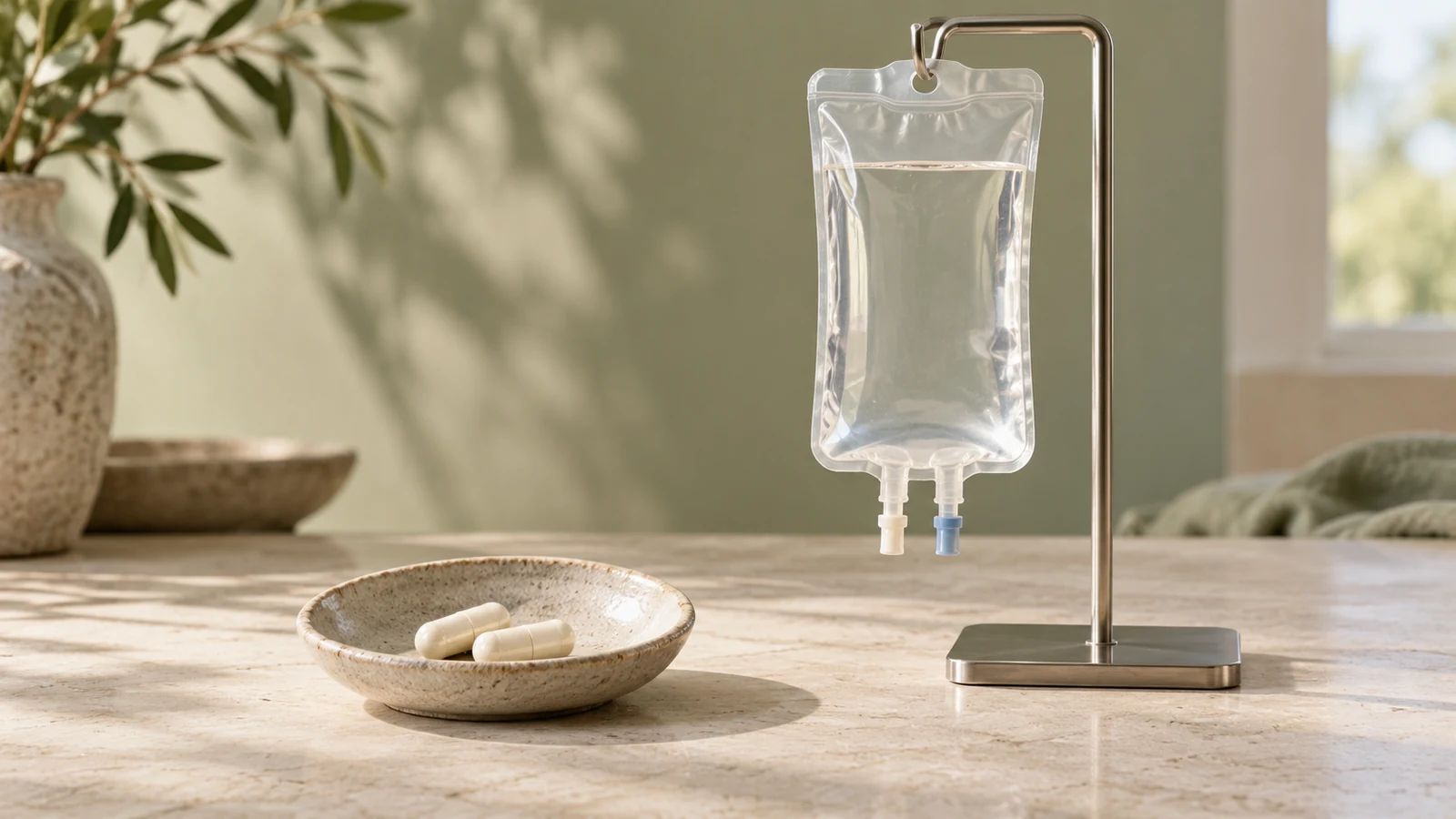
A capsule beside the breakfast cup or several hours in an infusion chair: the two experiences could hardly look more different. Both are promoted through the same biological story, NAD+, a molecule involved in cellular energy metabolism. The more elaborate procedure can feel like the more powerful option.
The human research gives a more specific picture. One trial tested how muscles respond to insulin. Another followed substances in blood and urine during an infusion. A third studied people with heart failure. None of these is a direct contest between NMN capsules and NAD+ infusions for everyday energy.
First, decode the names on the label
NAD+ stands for nicotinamide adenine dinucleotide. Cells use it in energy-related reactions and other essential processes. NMN, nicotinamide mononucleotide, is a precursor the body can use to make NAD+. NR, nicotinamide riboside, is another precursor; evidence for NR cannot simply be relabeled as evidence for NMN.
An NMN capsule supplies a starting material through digestion. An infusion introduces NAD+ into the circulation. Absorption, transport and metabolism still determine what happens afterward. Getting a substance into a vein does not establish how much reaches a particular tissue or what changes there.
Our guides to oral NMN and NR and NAD infusions cover those research strands separately.
Three studies, three different measurements
NMN and muscle metabolism. In Mihoko Yoshino and colleagues’ 2021 trial, 25 postmenopausal women with prediabetes and overweight or obesity received NMN or placebo for ten weeks. Muscle insulin sensitivity improved: the muscles responded better to insulin’s signal to take up glucose. Body composition and several routine metabolic measures did not improve. This finding concerns glucose handling in a defined group; it does not establish that taking a capsule makes an otherwise healthy person feel more energetic.
NAD+ and its journey through the body. Ross Grant and colleagues’ 2019 pilot included 11 healthy men, eight receiving NAD+ and three saline. Researchers collected blood and urine during a six-hour infusion to follow NAD-related metabolites. Those samples helped describe how the body processes the infusion. They did not show that participants could walk farther, work longer or live longer.
NAD+ and a weakened heart. Xiaofan Yu and colleagues studied 180 patients with ischemic heart failure. NAD+ was added to standard treatment for seven days. The main measurement was left ventricular ejection fraction, or LVEF: the proportion of blood the heart’s main pumping chamber ejects with each beat. It improved at one month. The difference in major cardiovascular and cerebrovascular events at six months was not statistically significant. This hospital trial does not establish a benefit for healthy infusion customers.
These studies are useful precisely because their outcomes are specific. A metabolite concentration, muscle insulin sensitivity and LVEF each describe a different part of physiology.
The practical comparison
Detail | NMN capsules | NAD+ infusion |
|---|---|---|
Substance delivered | A precursor used in NAD metabolism | NAD+ delivered into a vein |
Time and setting | Repeated oral use | An appointment, vein access and monitoring; research protocols vary |
Quality to document | Product identity, stated content and purity | Exact preparation, suitability for sterile use and handling |
Evidence to match | The same preparation, population and outcome | The same preparation, population, outcome and accompanying treatment |
Result established by these studies | Selected metabolic findings | Metabolism findings and a disease-specific cardiac result |
Turn “more energy” into something observable
Being able to finish a familiar walk, getting through the afternoon without unusual fatigue, and improving a diabetes-related measurement are different goals. A blood NAD result alone cannot tell you whether all three have improved.
For someone mainly troubled by persistent fatigue, the starting point is a medical assessment of that symptom. For someone with prediabetes, the comparison needs to include established care for glucose regulation. The assessment guide explains how a broad interest in longevity can become a focused care plan.
A useful written plan names the intended change, the starting measurement, the review date and the conditions for stopping. “Better afternoon stamina, recorded alongside sleep and activity” is more informative than an open-ended promise to optimize cellular energy. It also makes time and cost visible before repeated treatment begins.
Preparation matters as much as presentation
The US FDA’s sterile-compounding notice describes reports of severe chills, shaking, vomiting and fatigue after injectable NAD+ products, with some patients needing medical treatment. It highlights the use of unsuitable ingredients, including food-grade NAD+, in sterile preparations.
For an infusion, documentation of preparation, clinical supervision and management of reactions belongs alongside the proposed benefit. For a capsule, the corresponding essentials include the exact product and evidence of its identity and quality. A polished label or a comfortable treatment room cannot supply that information.
The decision becomes clearer when it is attached to a measurable health goal. At present, the studies discussed here provide no direct basis for declaring either route the winner for healthy longevity.
What remains uncertain
Study findings depend on the preparation, population and outcome. A change in a laboratory measurement does not by itself establish improved daily function or longer life.
References
- Yoshino M et al. Nicotinamide mononucleotide increases muscle insulin sensitivity in prediabetic women. Science. 2021. · Checked 2026-10-22
- Grant R et al. A Pilot Study Investigating Changes in the Human Plasma and Urine NAD+ Metabolome During a 6 Hour Intravenous Infusion of NAD+. Front Aging Neurosci. 2019. · Checked 2026-10-22
- Yu X et al. Effect of Nicotinamide Adenine Dinucleotide on Heart Failure Caused by Ischemic Cardiomyopathy: A Randomized, Placebo-Controlled Trial. American Journal of Cardiovascular Drugs. 2026; published online 2025. · Checked 2026-10-22
- U.S. FDA. FDA Reminds Compounders to Use Ingredients Suitable for Sterile Compounding (NAD+ Endotoxin Alert). · Checked 2026-10-22
Disclosure
Prepared with AI assistance for Healthy Longevity Science, published by Healthy Longevity Clinic. This comparison does not announce the availability of a particular product or procedure.